Best for
Who should buy it
Professionals and buyers who want a real analog watch on the wrist with clinical-grade health screening underneath; users who want one-month battery and no screen distraction.
 Our Method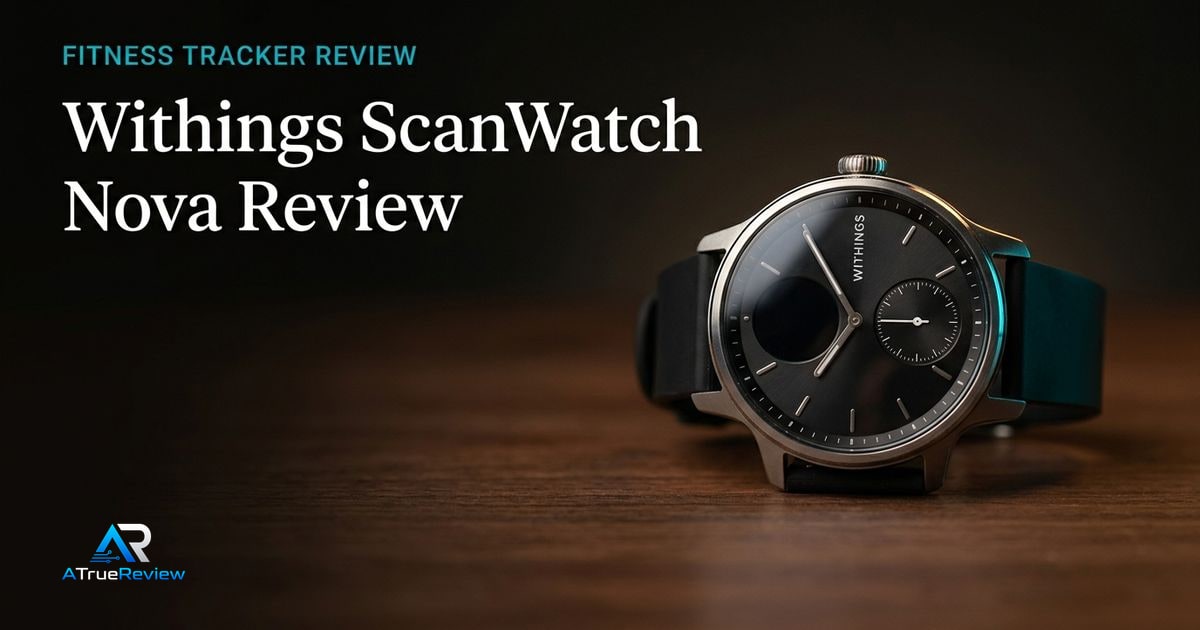
Smartwatch review
A review of Withings ScanWatch Nova as a hybrid analog health smartwatch, focused on its ECG and AFib detection, SpO2 and temperature tracking, sleep monitoring, and whether the analog form factor earns its place against Apple Watch and Garmin alternatives.
Verdict
Niche pick
The strongest current hybrid analog health watch — and the cleanest answer for buyers who want medical-grade screening without compromising on the look of a real watch.

Best for
Professionals and buyers who want a real analog watch on the wrist with clinical-grade health screening underneath; users who want one-month battery and no screen distraction.
Skip if
You want phone notifications and apps, you train competitively and need GPS / training metrics, or you want a watch that doubles as a notification center.
Test window
Launch brief based on Withings product documentation and independent long-term coverage. Hands-on multi-week wear, ECG and AFib detection accuracy validation against clinical reference, sleep apnea and respiratory scan reliability, and the 30-day battery against the real-world claim are still required before final scoring.
Specs
Key findings
The Withings ScanWatch Nova is the watch you wear when you want medical-grade health monitoring on your wrist and still need the device to look like an actual watch on a Tuesday in a meeting. The proposition is unique in 2026 — a hybrid analog smartwatch with real mechanical hour-and-minute hands, a small high-contrast OLED for data and notifications, and a clinical-grade sensor stack underneath that includes FDA-cleared ECG, AFib screening, on-demand and overnight SpO2, and 24/7 body-temperature tracking. The battery lasts 30 days.
It is not a wrist computer. It does not run apps, it cannot take phone calls, and it does not produce structured training plans. It does the things that matter to a specific buyer profile — the professional, the executive, the dress-watch wearer who also wants clinical-screening-grade data — better than anything else on the market.
The form factor is the entire pitch. Per TechRadar’s review, the watch reads as a traditional 42 mm stainless steel timepiece with sapphire crystal on the Brilliant editions, mechanical hour-and-minute hands, and an activity progress sub-dial. The small embedded OLED display sits inside the watch face for notifications, ECG readings, sleep data, and menu navigation — present when you need it, invisible when you do not. The result is a watch that works in dress shirts, meetings, weddings, and business travel without signaling “tech device” the way a 49 mm Apple Watch Ultra 3 or 51 mm Garmin Fenix 8 does.
The health-sensor stack is the second pillar. Withings packs four sensors on the case back — optical heart-rate, a single-lead ECG, SpO2, and the TempTech24/7 module — and ties them into one of the most clinically grounded consumer health apps in the category. Per Android Authority’s review, the ECG is FDA-cleared with Irregular Rhythm Notifications for AFib, the Respiratory Scan combines SpO2 and breathing-disturbance signals into one overnight analysis, and the TempTech24/7 layer samples body temperature continuously rather than only overnight — producing a personalized baseline that flags deviations 24–48 hours before symptoms typically surface.
The cross-platform support is the third quiet strength. Per Techaeris’s review, Withings Health Mate runs at full parity on iOS and Android, with PDF-exportable ECGs, sleep reports that integrate with Apple Health and Google Health Connect, and a consistent UX across both platforms. Buyers who switch phones or live in a mixed-platform household do not lose health continuity.
Conditionally. Both share the same core health-sensor stack — ECG, SpO2, TempTech24/7, sleep — and the same Withings Health Mate platform. The Nova is the premium edition with a more refined case, sapphire crystal on Brilliant editions, and updated design. ScanWatch 2 is the original line that still ships at a meaningfully lower price.
Buyers picking between the two should match by use case. The Nova is the right pick for buyers who want the premium look and are willing to pay for the Brilliant edition’s sapphire crystal and case finishing. The ScanWatch 2 is the right pick for buyers who want the same health stack at a lower price point and do not specifically want the dressier styling.
Two real limitations matter for buying decisions.
A hybrid analog watch is the wrong choice for buyers who actually want a smartwatch. The look and the battery only pay back when you genuinely do not want notifications on your wrist.
— The honest framing
First, the workout-instrumentation gap. The ScanWatch Nova has no on-watch GPS — it relies on connected GPS through the paired phone — no music storage, no NFC payments, and no third-party apps. As an everyday health-screening watch, that minimalism is part of the point. As a workout instrument, it falls multiple generations behind a Garmin Forerunner 965 or Apple Watch Ultra 3. Runners and athletes who train structured should buy a sport watch and consider the Nova as a separate dress-wear piece.
Second, the notification ceiling. The small embedded OLED can surface caller ID, message previews, and calendar alerts, but it cannot answer calls, dictate replies, or run apps. For buyers who want a wrist-based communication device, the Nova is the wrong shape of product. The Garmin Venu 3 review covers the lifestyle AMOLED Garmin with Bluetooth calls and broader smart features; the Apple Watch Ultra 3 covers the cellular alternative.
There are softer caveats too. The Health Mate app, while solid and clinically credible, lacks Oura’s editorial polish or Strava’s social layer. The $599 MSRP for the Brilliant editions sits in serious-smartwatch territory and competes against discounted Forerunner 965 inventory. And the analog hands occasionally obscure parts of the small OLED data display — a real-watch trade-off that takes a couple of weeks to internalize.
Before any final scoring, the site needs to test multi-week wear, ECG and AFib detection accuracy validation against clinical reference, Respiratory Scan reliability across sleep sessions, the TempTech24/7 baseline drift over a multi-month window, the 30-day battery against the real-world claim, and the analog-hands-versus-OLED legibility ergonomics over extended daily wear.
Three real alternatives serve different buyers:
The Apple Watch Ultra 3 is the iOS-only wrist computer with cellular, satellite messaging, hypertension and sleep-apnea screening, ECG, and a full app ecosystem. Trade-off: daily charging, no analog look, $799 starting price.
The Garmin Venu 3 is the lifestyle AMOLED Garmin — broader notifications, Bluetooth calls, two-week battery, fuller activity tracking layer, $449 MSRP. The right pick when notifications and casual fitness matter more than analog styling.
The Oura Ring 4 is the screen-free recovery alternative — finger-based passive tracking, subscription-required, no notifications. The right pick when the wrist real-estate is not the point at all.
The Withings ScanWatch Nova wins when the buyer wants a watch that genuinely looks like a real timepiece, with clinical-grade health screening underneath, and one-month battery autonomy.
For shortlist context around that decision, the best fitness trackers guide shows where Nova sits relative to Apple Watch Ultra 3 and Garmin Venu 3, the fitness-trackers category narrows the wearable-only layer, and the wider wearables hub helps buyers decide whether the right answer is a watch, a ring, a strap, or a broader sleep-and-recovery setup. For a complete recovery setup that pairs with the watch, the Eight Sleep Pod 4 review covers the bedroom-level upgrade.
If you want a real-looking watch on your wrist with FDA-cleared ECG, 24/7 temperature, SpO2, and sleep monitoring underneath, and one-month battery autonomy that ends daily charging anxiety, the Withings ScanWatch Nova is the cleanest current pick. If you want a wrist computer with cellular and apps, the Apple Watch Ultra 3 is the alternative. If you want lifestyle AMOLED at a lower price with Bluetooth calls and broader smart features, the Garmin Venu 3 is the AMOLED alternative. If you want passive recovery and sleep tracking on the finger with no wrist device at all, the Oura Ring 4 is the parallel.
The provisional verdict: the strongest current hybrid analog health-watch recommendation, contingent on multi-week wear, ECG / AFib detection accuracy validation, Respiratory Scan reliability across sleep sessions, TempTech24/7 baseline drift over multi-month windows, and the 30-day battery against the real-world claim. Final score depends on real-world wear and clinical-screening evaluation. For shortlist context, route back through best fitness trackers, fitness trackers, or the wider wearables hub.
Verdict shape
Pros
Cons
Alternatives
FAQ
Three reasons that matter to a specific buyer. First, the watch reads as a real watch in dress and professional environments where Apple Watch or Garmin signal "tech device." Second, the 30-day battery completely removes the daily-charging routine that defines AMOLED watches. Third, the analog face plus small data OLED means the watch is not a continuous notification center — it shows the time, it surfaces a clinical alert if needed, and otherwise stays out of the way. For buyers who want medical-grade screening without becoming a wrist-computer user, the ScanWatch Nova is the cleanest answer in 2026.
Yes — Withings has FDA clearance in the US and CE marking in Europe for the ScanWatch ECG. Readings produce a clinician-shareable PDF through the Withings Health Mate app and are usable as a screening-grade tool, particularly for documenting palpitation episodes during the moment. As with every consumer ECG (Apple Watch, Samsung Galaxy Watch, Whoop MG), the watch is a screening device, not a diagnostic — a flagged reading is the prompt to see a clinician.
Withings' TempTech24/7 is a dedicated body-temperature sensor that samples continuously rather than only overnight. The watch builds a personalized baseline over the first couple of weeks and then surfaces deviation alerts when temperature drifts meaningfully. Practical uses: spotting the onset of illness 24–48 hours before symptoms, tracking ovulation cycles for buyers using the watch for fertility awareness, and validating thermoregulation during sleep alongside the ring or strap data.
No — the ScanWatch Nova does not have a microphone or speaker. Calls show as caller-ID notifications on the small embedded OLED, but cannot be answered or dictated from the watch. Buyers who want on-wrist calls should look at the [Garmin Venu 3 review](/reviews/garmin-venu-3-review/) (Bluetooth calls via paired phone) or the [Apple Watch Ultra 3 review](/reviews/apple-watch-ultra-3-review/) (full cellular calls).
Withings has the broader continuous-health story — 24/7 temperature, longer sleep window per charge, and a Respiratory Scan that combines SpO2 and breathing-disturbance signals into one analysis. Apple Watch Ultra 3 has the broader screening story — sleep apnea notifications, hypertension notifications, fall detection, crash detection, ECG. Apple wins on integration with iPhone Health and emergency features; Withings wins on continuous data and the analog form factor. See the [Apple Watch Ultra 3 review](/reviews/apple-watch-ultra-3-review/) for the wrist-computer alternative.
Different buyers. Garmin Venu 3 wins on notifications, Bluetooth calls, on-watch animated workouts, and price ($449 vs $599). Withings ScanWatch Nova wins on analog looks, 30-day battery, ECG, and 24/7 temperature. Lifestyle buyers who want a smartwatch lean Venu 3; clinically-curious buyers who want a real watch first and a health monitor second lean ScanWatch Nova. The [Garmin Venu 3 review](/reviews/garmin-venu-3-review/) covers the AMOLED alternative.
Both share the same health-sensor stack — ECG, SpO2, TempTech24/7, sleep. ScanWatch Nova is the premium edition with a more refined case, sapphire crystal on Brilliant editions, and updated design. ScanWatch 2 is the original line and typically sells at a meaningful discount. For buyers who want the same health stack at a lower price, the older ScanWatch 2 is still in production and worth cross-shopping; for buyers who want the premium look, the Nova is the upgrade.
Up to 30 days on a single charge, thanks to the analog watch face and a minimal-power OLED secondary display.
Yes. A clinically validated single-lead ECG with Irregular Rhythm Notifications for AFib, plus SpO2 and 24/7 body temperature.
No. It is a hybrid analog watch with real mechanical hands and a small embedded OLED for digital readouts and notifications.
It is 10 ATM (100 m) water-resistant, swim-rated and sauna-safe but not dive-rated.
Yes. It pairs with the Withings Health Mate app on both iOS and Android; it has no cellular, Wi-Fi, or NFC payments.