Best for
Who should buy it
Serious runners, duathletes, and triathletes who want Garmin's full training-readiness stack on AMOLED with multi-band GPS, multi-day battery, and no premium dive-watch bezels.
 Our Method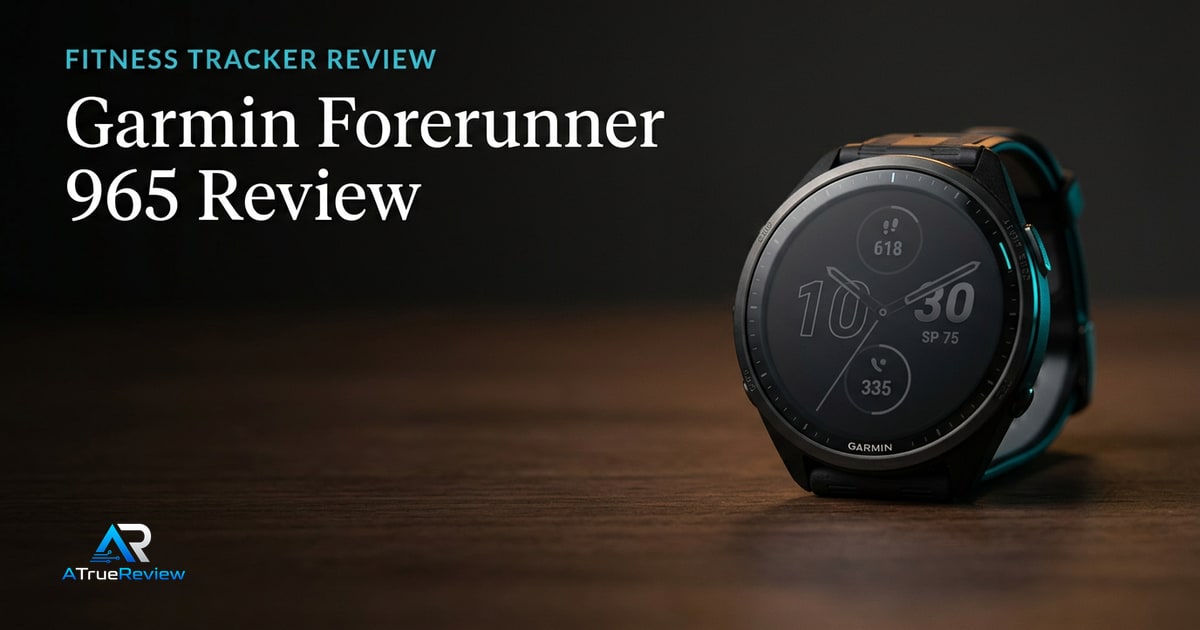
Smartwatch review
A review of Garmin Forerunner 965 as a flagship running watch with multi-band GPS, AMOLED display, and Garmin's training-readiness stack, focused on whether it remains the right pick now that the Forerunner 970 is shipping.
Verdict
Recommended
The strongest current value pick in the serious running-watch category — particularly for runners who do not need the new sensor stack of the Forerunner 970 and want a deeply discounted price as that model ages.

Best for
Serious runners, duathletes, and triathletes who want Garmin's full training-readiness stack on AMOLED with multi-band GPS, multi-day battery, and no premium dive-watch bezels.
Skip if
You want the latest sensor stack with the Forerunner 970, you need real multisport breadth and dive mode (Fenix 8 territory), you require cellular or iPhone-native apps, or you only run casually.
Test window
Launch brief based on Garmin product documentation and independent long-term coverage. Hands-on multi-week wear, AMOLED battery against the 23-day claim, multi-band GPS accuracy against chest-strap heart-rate reference, and Garmin Coach 2 training-plan effectiveness are still required before final scoring.
Specs
Key findings
The Garmin Forerunner 965 is the cleanest answer for runners who want the full premium Garmin training stack without paying Fenix 8 money. As of 2026, the watch sits in an unusual position — the Forerunner 970 successor has shipped, the price has settled below MSRP, and the 965 has effectively become the value-tier flagship AMOLED running watch in the Garmin lineup. For most runners, this is exactly the moment to buy.
The proposition is straightforward. Multi-band GPS, 1.4” AMOLED display, 23-day smartwatch battery, full TopoActive mapping, daily suggested workouts via Garmin Coach 2, Training Readiness, Recovery Time, race-time predictor, and the rest of Garmin’s premium running stack — at $599.99 list and frequently meaningfully less. The watch that the Fenix 8 trades adventure breadth for, but the watch that most pure runners actually need.
The AMOLED display is the first thing every reviewer mentions, and the practical reason is right — Garmin’s previous flagship Forerunner generations were stuck on transflective MIP panels that were excellent in direct sunlight but visually flat indoors. Per Trusted Reviews’ coverage, the 1.4” AMOLED at 454×454 px reads cleanly indoors, in sun, and overnight, and gives up much less battery than the MIP-to-AMOLED transition does on Apple Watch or Galaxy Watch. Garmin claims up to 23 days of smartwatch use in gesture-on mode and up to 7 days in always-on — independent long-term reviewers report 12–18 days of real-world mixed use including daily runs, which is meaningfully better than any AMOLED competitor at this price.
The training stack is Garmin’s full premium running layer. As DC Rainmaker’s launch review documents in detail, the 965 ships Training Readiness (the daily go/hold/recover signal that Garmin builds from sleep, HRV, recovery time, and training load), Recovery Time, race-time predictor, training load focus, real-time stamina during workouts, and daily suggested workouts via Garmin Coach 2 — the same training stack the Fenix 8 ships. For runners who specifically want the suggested-workouts coaching layer, the 965 produces the same daily output as a Fenix at half the price.
The multi-band GPS layer matters more than display refinements for serious runners. The 965’s dual-frequency L1 + L5 GNSS with SatIQ adaptive accuracy reads cleanly against chest-strap heart rate and reference GPS units in trail running, dense urban canyon, and tree-cover environments. For trail runners and ultramarathoners specifically, this is the GPS implementation that justifies the watch over a Forerunner 265 or 255.
For most casual runners, no. The Forerunner 265 covers AMOLED, Garmin Coach training plans, and core training metrics at a meaningfully lower price; the Forerunner 255 covers the same with a transflective display for runners who prefer outdoor readability over color richness. The 965 earns its premium when the buyer actually wants multi-band GPS, full TopoActive mapping, ClimbPro, daily suggested workouts via Coach 2, and Training Readiness — features that scale to serious training and racing in ways the lower-tier Forerunners do not.
Three runner profiles where the 965 reads as a clear yes:
For pure runners doing road 5K and 10K races without structured training plans, the Forerunner 265 is the smarter purchase.
Two real limitations matter for buying decisions.
A great running watch is not a great dive watch. Buyers who actually dive or do multisport adventure should pay the Fenix premium, not stretch a Forerunner past its job.
— The honest framing
First, the 5 ATM water rating. The Forerunner 965 is swim-rated, not dive-rated — fine for pool swims, open-water training, and showering, but not for snorkeling at depth or recreational diving. Buyers who actually dive need the Garmin Fenix 8, which adds EN13319 dive certification and a proper dive-computer mode.
Second, the missing wrist-computer layer. The Forerunner 965 has no cellular, no microphone, no speaker, no satellite messaging, and no real third-party app ecosystem. For runners who train with a phone in pocket and do not need notifications-from-the-wrist, none of this matters. For runners who want a watch they can take to a coffee shop without their phone, the Apple Watch Ultra 3 is the alternative — at significantly higher cost and with iPhone-only compatibility.
There are softer caveats too. Garmin Connect’s UI continues to read as utilitarian compared to Strava’s social layer or Whoop’s coaching framing. The 970 successor is the watch most reviewers now feature in head-to-head comparisons, which makes the 965 read as the “good value but one generation behind” pick rather than the current flagship. Most existing Forerunner 965 owners do not feel a strong upgrade pull to the 970 unless they specifically want ECG or the new sensor.
Before any final scoring, the site needs to test multi-week wear comfort, AMOLED battery against the 23-day gesture-on claim under real running load, multi-band GPS accuracy against chest-strap heart-rate reference in trail and urban canyon conditions, daily suggested workouts effectiveness across a training cycle, and the real-world price floor as the Forerunner 970 continues to take retail attention.
Three real alternatives serve different buyers:
The Garmin Fenix 8 is the same training stack on an adventure-focused body — dive mode, microphone-and-speaker, leak-proof inductive buttons, multiple case sizes, premium materials. At twice the price, it is the right pick only when the buyer actually needs dive computing or multisport breadth.
The Apple Watch Ultra 3 is the iOS-only daily-driver smartwatch with cellular, satellite messaging, ECG-and-hypertension health screening, and a richer app ecosystem. Trade-off: daily charging, weaker training-specific depth, iPhone-only.
The Polar Vantage V3 is the non-Garmin / non-Apple endurance trainer — Polar’s sport-science-leaning training metrics, AMOLED display, no Garmin ecosystem lock-in. See the Polar Vantage V3 review for the alternative ecosystem.
The Garmin Forerunner 965 wins when the buyer is a serious runner or multisport athlete who wants Garmin’s full premium training stack at the cheapest defensible price, on a lighter case that disappears overnight, with cross-platform Garmin Connect compatibility.
For shortlist context around that decision, the best fitness trackers guide shows where Forerunner 965 sits relative to Fenix 8 and Apple Watch Ultra 3, the fitness-trackers category narrows the wearable-only layer, and the wider wearables hub helps buyers decide whether the right answer is a watch, a ring, a strap, or a broader sleep-and-recovery setup. For a complete recovery setup that pairs with the watch, the Eight Sleep Pod 4 review covers the bedroom-level upgrade.
If you are a serious runner, duathlete, or triathlete who wants Garmin’s full premium training stack — Training Readiness, daily suggested workouts via Coach 2, multi-band GPS, full TopoActive mapping, AMOLED display, 23-day battery — at the cheapest defensible price, the Forerunner 965 is the right answer in 2026. If you specifically want the newer Elevate Gen 5 sensor and ECG, the Forerunner 970 is the direct successor. If you actually dive or need multisport breadth, the Garmin Fenix 8 is the honest upgrade. If you are on iPhone and want a daily-driver smartwatch with cellular and apps, the Apple Watch Ultra 3 is the alternative.
The provisional verdict: the strongest current value running watch recommendation, contingent on multi-week wear validation, AMOLED battery under real training load, multi-band GPS accuracy against chest-strap reference, daily suggested workouts effectiveness across a training cycle, and confirmation of real-world street pricing at purchase time. Final score depends on real-world wear and training-use evaluation. For shortlist context, route back through best fitness trackers, fitness trackers, or the wider wearables hub.
Verdict shape
Pros
Cons
Alternatives
FAQ
For most buyers, yes — and arguably more than at launch. The 970 adds an updated Elevate Gen 5 sensor, ECG support, and refined training metrics, but the 965 still ships the full premium training stack, multi-band GPS, 23-day battery, and AMOLED display. With the 970 on the market, the 965 has been settling at a real-world discount that makes it the best value AMOLED running watch in the Garmin lineup. The 970 is the right pick for buyers who specifically want ECG and the newer sensor; the 965 is the right pick for buyers who want flagship features at a discount.
Same software stack, different hardware focus. Fenix 8 adds dive-computer mode, microphone-and-speaker, leak-proof inductive buttons, multiple case sizes, and premium materials — at roughly twice the price. Forerunner 965 is lighter, runs the same training metrics, has the same multi-band GPS, and disappears on the wrist during overnight wear. Pure runners and duathletes lean Forerunner 965; multisport adventurers with dive or expedition needs lean Fenix 8. See the [Garmin Fenix 8 review](/reviews/garmin-fenix-8-review/) for the adventure-focused alternative.
Better than initial Apple Watch / Galaxy Watch comparisons suggest. Garmin claims up to 23 days in gesture-on smartwatch mode and up to 7 days with always-on display. Independent long-term reviewers consistently report 12–18 days of real-world mixed use including daily runs and indoor training. The always-on penalty is real — most buyers settle on the gesture-on default to keep the battery story closer to Garmin's traditional autonomy.
Both, fully. Garmin Forerunner 965 pairs cleanly with iOS and Android via the Garmin Connect app, with no feature loss on either platform. This is one of the major reasons multisport athletes lean Garmin over Apple — the watch outlives a phone-platform switch.
For active training, yes — Whoop and Oura cover 24/7 recovery but neither provides in-workout GPS, structured training plans, or mid-run pace and heart-rate visibility. Many serious runners wear the Forerunner 965 alongside an [Oura Ring 4](/reviews/oura-ring-4-review/) or [Whoop 5.0](/reviews/whoop-5-review/) — the watch handles workouts, the ring or strap handles passive sleep and recovery framing.
For casual runners, the Forerunner 265 (AMOLED) or 255 (MIP) at lower price points are the sensible step down — both ship Garmin Coach training plans, GPS, and core training metrics. The 965 only earns its premium if the buyer actually wants multi-band GPS, full TopoActive mapping, daily suggested workouts via Coach 2, and Training Readiness. Pure beginners and 5K/10K-only runners do not need the 965.
For most runners, no — the Forerunner 965 is designed to be worn during runs where on-watch calls are not part of the workflow. Buyers who want to take calls from the wrist, use voice assistants, or capture voice notes during training need either the [Garmin Fenix 8](/reviews/garmin-fenix-8-review/) (which added those features) or the [Apple Watch Ultra 3](/reviews/apple-watch-ultra-3-review/).
Up to 23 days in smartwatch mode, up to 31 hours in single-band GPS, and up to 19 hours in multi-band GPS.
A 1.4-inch AMOLED touchscreen at 454x454 px.
Yes. Multi-band, multi-GNSS (GPS L1+L5, GLONASS, Galileo, QZSS, BeiDou) with SatIQ adaptive accuracy.
It is 5 ATM (50 m) water-resistant, swim-rated but not dive-rated.
$599.99 MSRP, with real-world street price typically below MSRP now that the Forerunner 970 has shipped.