Best for
Who should buy it
iPhone owners who want a single wrist device that handles workouts, comms, ECG-grade health screening, and satellite/cellular independence in the backcountry.
 Our Method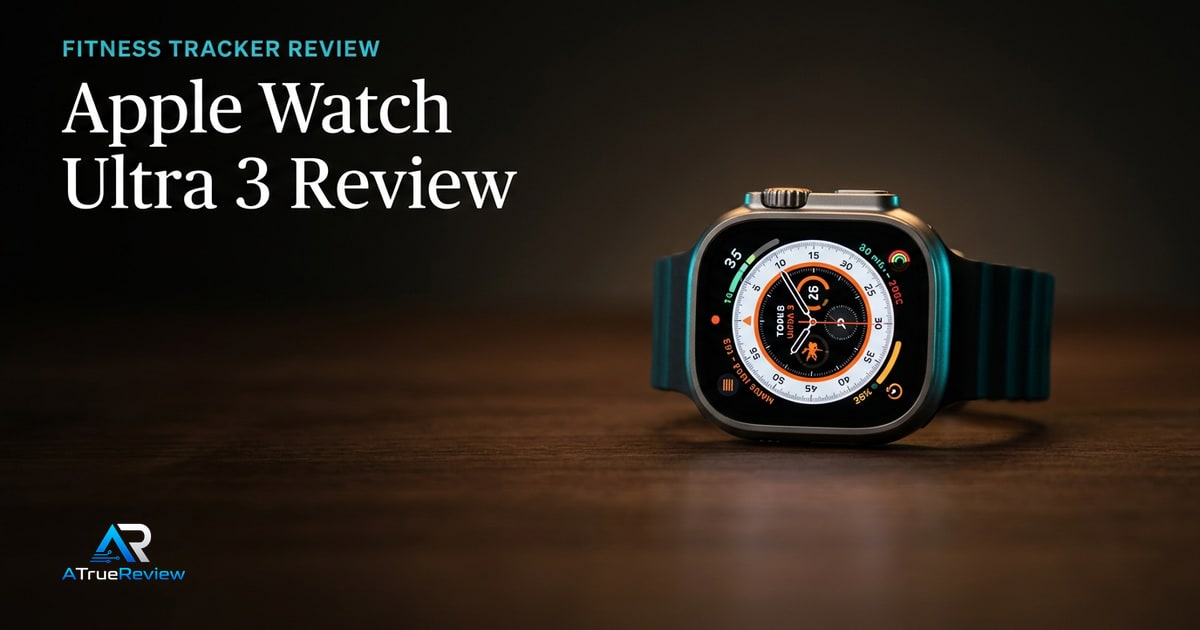
Smartwatch review
A review of Apple Watch Ultra 3 as a flagship health-and-adventure smartwatch, focused on hypertension notifications, sleep apnea detection, satellite messaging, battery life, and whether the upgrade from Ultra 2 is worth $799.
Verdict
Recommended
The most complete current health smartwatch for buyers inside the Apple ecosystem — and the most defensible recommendation against a Garmin or Whoop for daily-driver wear, contingent on hands-on multi-week validation.

Best for
iPhone owners who want a single wrist device that handles workouts, comms, ECG-grade health screening, and satellite/cellular independence in the backcountry.
Skip if
You use an Android phone, you want a wearable that lasts a week per charge, you want passive recovery tracking without a screen, or you do not have enough adventure use cases to justify the premium over Apple Watch Series 11.
Test window
Launch brief based on Apple Newsroom announcement, Apple support specifications, and independent post-launch coverage. Hands-on multi-week wear, sleep apnea accuracy, hypertension notification calibration, satellite SOS / messaging reliability, and real-world battery against the 42-hour claim are still required before final scoring.
Specs
Key findings
The Apple Watch Ultra 3 is the most complete health-and-comms smartwatch shipping in 2026. That sentence sounds like marketing — it is also accurate, in the narrow sense that no other wrist device combines a flagship-tier health stack (ECG, blood oxygen, sleep apnea, the new hypertension notifications), a true backcountry comms layer (5G cellular plus three flavors of satellite), and the kind of daily-driver smartwatch UX that makes a Garmin feel utilitarian by comparison. The trade is that Apple Watch Ultra 3 is also locked to the iPhone, still wants charging every day or two, and asks $799 to get past the upgrade gate of the Apple Watch Series 11.
For the right buyer — an iPhone owner who wants one wrist device for everything — the Ultra 3 is the most defensible $800 in this category. For everyone else, the alternative ladder is well-stocked.
The hardware refresh is real, even if the marketing language flattens it. Per Apple’s Ultra 3 announcement and the official technical specifications, the watch ships with the S10 SiP, an LTPO3 always-on Retina display at up to 3000 nits in the largest case Apple has built (~5% more screen area than Ultra 2), and a 49 mm titanium body in Natural or Black Titanium. Battery life climbs to up to 42 hours in regular use and up to 72 hours in Low Power Mode — meaningfully better than Ultra 2’s 36-hour figure, even if it still asks for charging more often than a Garmin or a Whoop.
The display upgrade is the change most reviewers single out. Per TechRadar’s Ultra 3 review, the new wide-angle LTPO3 panel reads cleanly at sharper off-axis angles, dims more efficiently in always-on mode (which is the source of the battery gain), and refreshes the always-on state at 1 Hz so a ticking-second indicator becomes possible without burning power.
The health stack is where the Ultra 3 most clearly extends past the rest of the category. The existing notifications — ECG, irregular rhythm, blood oxygen, temperature, fall detection, crash detection — are joined by two screening-grade additions: sleep apnea notifications (which use the accelerometer to flag breathing-disturbance patterns over a rolling 30-day window) and the new hypertension notifications (which read how blood vessels respond to heartbeats via the optical sensor across the same rolling window). Neither produces a numeric diagnostic readout; both produce a “see a clinician” prompt when a pattern emerges. As AppleInsider noted in its launch review, this layer is the most substantive evolution of the platform since the original Series 4 ECG.
GPS precision is the third area where the watch has measurably moved. The dual-frequency L1 + L5 antenna has been verified against chest-strap heart rate and reference GPS in multiple independent reviewer comparisons — DC Rainmaker’s Ultra 3 in-depth coverage is the most rigorous example — and routinely lands within Garmin-class accuracy on running, cycling, and hiking workouts.
For most existing Ultra 2 owners, only conditionally. The Ultra 3 is unambiguously better than the Ultra 2, but most of the gains are evolutionary — display refinements, slightly longer battery, 5G, hypertension notifications, satellite messaging. None of those individually is category-shifting unless the buyer specifically needs that capability.
Three Ultra 2 owner profiles where the Ultra 3 upgrade reads as a yes:
For everyone else still on Ultra 2, holding is the right call. The watch is still excellent, and the next platform generation will almost certainly add features that justify a single upgrade leap.
For Apple Watch Series 9 / Series 10 / Series 11 owners considering an Ultra 3 jump, the question is different — it is whether you actually have backcountry, multisport, or heavy outdoor use cases that justify the $400+ premium over Series 11. Many readers do not; for them, the Series 11 is the smarter buy.
Two real limitations matter for buying decisions.
A wrist computer that needs charging every day or two is not a passive recovery instrument. Choose Apple Watch when you want a smartwatch first, not a sleep-and-recovery tracker.
— The honest framing
First, the ecosystem lock-in. Apple Watch — including Ultra 3 — only pairs with an iPhone, and there is no path to transfer the watch to an Android phone later. If you are an Android user, this is not a watch you can buy “to see how it goes” — it is a permanent iPhone commitment. The Garmin Fenix 8 review covers the cross-platform adventure-watch alternative.
Second, the sleep-tracking ceiling. Apple added a real Sleep Score in 2025, and the data the watch now collects overnight — heart rate, temperature, blood oxygen, respiratory rate, and the sleep apnea signal — is meaningfully better than it was on Series 6 or Series 8. But the watch still has the worst sleep-wear comfort of any major health wearable simply because it is a 49 mm wrist computer with a screen. For passive 24/7 sleep and recovery tracking, the Oura Ring 4 and Whoop 5.0 are still ahead on comfort and on multi-day battery autonomy.
Before any final scoring, the site needs to test multi-week wear comfort on the wrist (especially overnight), real-world battery life against the 42-hour claim across a mixed-use week, sleep apnea notification reliability against a polysomnography reference, hypertension notification calibration against cuff-measured blood pressure, satellite SOS / messaging reliability across cell-dead zones, and Action button programmability for triathlon / multisport use.
Three real alternatives serve different buyers:
The Garmin Fenix 8 is the cross-platform alternative — full topographic mapping, multi-week battery, structured-training depth that Apple still cannot match, and no ecosystem lock-in. Trades off cellular, app ecosystem, and notification polish.
The Oura Ring 4 is the opposite philosophy — a screen-free ring for passive sleep and recovery tracking, no display, no notifications, no GPS. The right pick when the wrist real-estate is not the point.
The Whoop 5.0 is the wrist-based recovery strap — same no-display philosophy as Oura, in a wrist form factor, with 14-day battery and subscription-only access to the strain-and-recovery coaching layer.
The Apple Watch Ultra 3 wins when the buyer is on iPhone, wants one wrist device for everything from workouts to ECG screening to backcountry comms, and accepts daily-ish charging as the trade for that completeness.
For shortlist context around that decision, the best fitness trackers guide shows where Ultra 3 sits relative to Garmin, Oura, and Whoop, the fitness-trackers category narrows the wearable-only layer, and the wider wearables hub helps buyers decide whether the right answer is a watch, a ring, a strap, or a broader sleep-and-recovery setup. For a complete recovery setup that pairs with the watch, the Eight Sleep Pod 4 review covers the bedroom-level upgrade.
If you are an iPhone owner who wants a single wrist device that handles workouts, communications, ECG-grade health screening, and backcountry-grade independence, and you actually engage adventure or multisport use cases, the Apple Watch Ultra 3 is the most defensible $799 in the category. If you are on Android, the Garmin Fenix 8 is the honest alternative. If you want passive sleep and recovery without a screen, the Oura Ring 4 or Whoop 5.0 are the parallel options. If your real use case is daily wear with health notifications but no serious outdoor demand, the Apple Watch Series 11 is the smarter buy.
The provisional verdict: the strongest current health-smartwatch recommendation for adventure-and-multisport iPhone owners, contingent on multi-week wear comfort, real-world battery against the 42-hour claim, sleep apnea and hypertension notification accuracy, and satellite SOS / messaging reliability under load. Final score depends on real-world wear and outdoor-use evaluation. For shortlist context, route back through best fitness trackers, fitness trackers, or the wider wearables hub.
Verdict shape
Pros
Cons
Alternatives
FAQ
For most current Ultra 2 owners, no — not on its own. The Ultra 3 is genuinely better, but most of the gains (5G, satellite messaging, hypertension notifications, the new LTPO3 display, 42-hour battery up from 36) are evolutionary rather than category-shifting. Buyers most likely to feel the upgrade are: backcountry users who will rely on satellite messaging, people with hypertension monitoring needs, and Ultra 1 owners still on the older chip. Casual daily-driver users on Ultra 2 can wait a generation.
It is a screening signal, not a diagnostic. The Ultra 3 uses the accelerometer to monitor subtle wrist movements associated with breathing-pattern interruptions over a rolling 30-day window. If a consistent pattern of moderate-to-severe sleep apnea emerges, the watch notifies you with a recommendation to see a clinician. False positives and false negatives are both possible. Treat a notification as the prompt to schedule a sleep study, not as a diagnosis.
The watch uses its optical heart-rate sensor to analyze how blood vessels respond to each heartbeat across a rolling 30-day window. If a consistent pattern suggesting hypertension emerges, the watch surfaces a notification recommending a clinical blood-pressure measurement. The feature does not produce a numeric blood-pressure reading — it is a screening tool that points buyers toward proper measurement. Availability varies by country as Apple expands regulatory clearance.
Different categories of athlete. Apple Watch Ultra 3 is the best wrist device if you want notifications, apps, satellite messaging, cellular, ECG, hypertension screening, and a daily-driver smartwatch that also handles backcountry adventure. Garmin Fenix 8 is the best wrist device if you want multi-week battery, full topographic mapping without a phone in range, no ecosystem lock-in, and structured-training depth that Apple still cannot match. Most multisport athletes who can afford only one watch end up choosing based on phone OS — iPhone owners lean Ultra 3, Android owners lean Fenix.
No. Apple Watch — including Ultra 3 — only pairs with an iPhone, and you cannot transfer it to an Android phone later. If you are an Android user shopping for a flagship adventure smartwatch, the [Garmin Fenix 8 review](/reviews/garmin-fenix-8-review/) is the right path; if you want a wrist health device without ecosystem lock-in, the [Whoop 5.0 review](/reviews/whoop-5-review/) covers the strap option.
For backcountry hikers, climbers, sailors, and people who travel through cell-dead zones, yes. The Ultra 3 supports Satellite SOS, satellite text messaging to compatible contacts, and Satellite Find My location sharing without a Garmin inReach or Apple iPhone 14+ acting as a relay. For urban daily-driver users who never leave cell coverage, it is a feature that may never trigger — and that is the right outcome.
Apple Watch Ultra 3 added Sleep Score in 2025, which is a meaningful improvement, but the watch still has the worst sleep-wear comfort of the three options simply by being a 49 mm wrist computer. For passive 24/7 sleep tracking on a device that disappears overnight, the [Oura Ring 4](/reviews/oura-ring-4-review/) and [Whoop 5.0](/reviews/whoop-5-review/) are the honest recommendations. For daytime active health on the wrist plus screening-grade overnight data, Ultra 3 is fine.
Up to 42 hours in regular use and up to 72 hours in Low Power Mode; fast charging reaches 0 to 80% in roughly 45 minutes.
Its always-on LTPO3 OLED Retina display reaches up to 3000 nits and is the largest screen of any Apple Watch.
It is WR100 (100 m) and EN13319 compliant, suitable for recreational scuba diving to 40 m.
It offers single-lead ECG, blood-oxygen, on-wrist temperature, sleep apnea notifications, and hypertension notifications over a rolling 30-day analysis.
Yes. It adds 5G cellular plus Satellite SOS, satellite text messaging, and Satellite Find My, with precision dual-frequency (L1 + L5) GPS.