Best for
Who should buy it
Wellness-focused buyers who want a Garmin watch for daily wear, sleep, stress, and casual training; wheelchair users who specifically need adapted activity tracking; cross-platform iOS / Android households.
 Our Method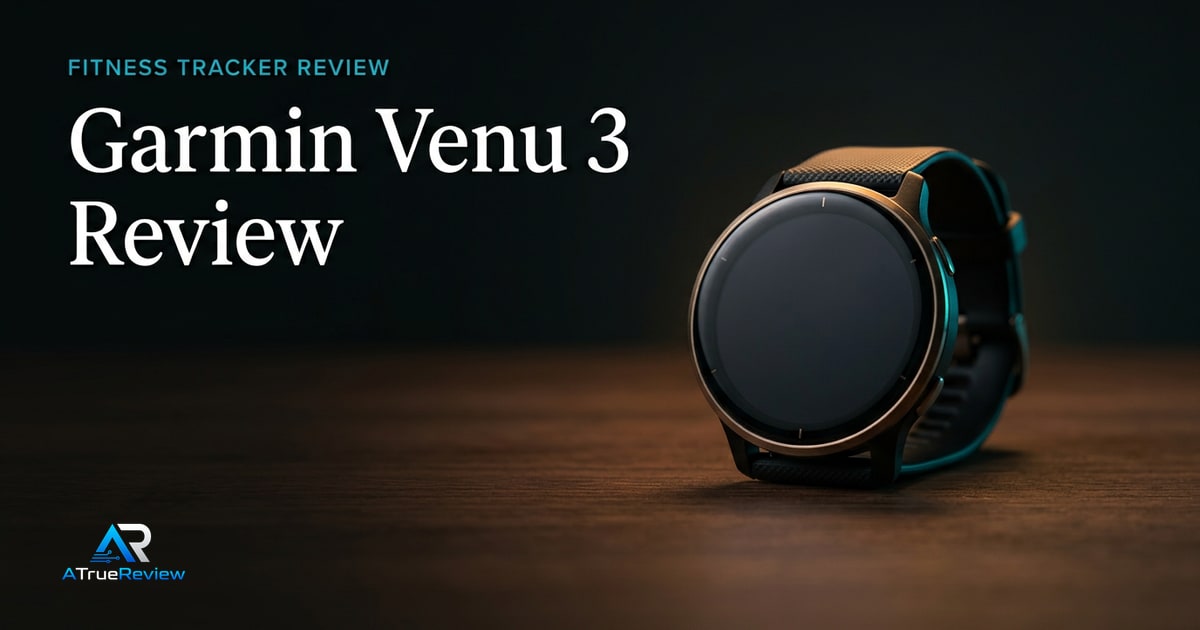
Smartwatch review
A review of Garmin Venu 3 as a lifestyle health smartwatch, focused on AMOLED display, two-week battery, Bluetooth phone calls, nap detection, Wheelchair Mode, and whether it earns a place against Apple Watch Series 11 and Forerunner 965 for daily wear.
Verdict
Recommended
The strongest current lifestyle-leaning Garmin smartwatch — particularly for buyers who want Garmin's health and training credibility on a thinner, more wearable case without paying for adventure features they will never use.

Best for
Wellness-focused buyers who want a Garmin watch for daily wear, sleep, stress, and casual training; wheelchair users who specifically need adapted activity tracking; cross-platform iOS / Android households.
Skip if
You train competitively (Forerunner 965 or Fenix 8 are the right picks), you want cellular and an app ecosystem (Apple Watch Ultra 3 is the answer), or you need multi-band GPS for trail running.
Test window
Launch brief based on Garmin product documentation and independent long-term coverage. Hands-on multi-week wear, AMOLED battery against the 14-day claim, Bluetooth call quality, nap-detection accuracy, and Wheelchair Mode validation are still required before final scoring.
Specs
Key findings
The Garmin Venu 3 is the watch Garmin built for the buyer who wants Garmin’s health and wellness credibility without paying for Fenix-tier adventure capability they will never use. The proposition is clean — a 1.4” AMOLED display, up to 14 days of smartwatch battery, Bluetooth phone calls from the wrist, and Garmin’s full wellness layer including Body Battery, sleep coaching, nap detection, and the jet lag advisor — at $449.99 MSRP on a case that disappears under a long sleeve.
It is not the watch for serious runners (the Forerunner 965 is) and it is not the watch for multisport adventurers (the Fenix 8 is). It is the right answer for the buyer who wants one Garmin watch for daily wear, sleep tracking, and casual training, on any phone platform.
The lifestyle positioning shows up first in the wear comfort. Per Android Central’s hands-on review, the 45 mm Venu 3 weighs ~47 g and the smaller 41 mm Venu 3S weighs ~40 g — both meaningfully lighter than the Fenix 8 51 mm Sapphire or even the Forerunner 965, and both with the same 1.4” / 1.2” AMOLED touchscreen panel. The smaller 3S in particular is the cleanest small-wrist Garmin in current production, and one of the few flagship-tier health smartwatches that fits a sub-16 cm wrist without dominating it.
The battery story is the second pillar. Per Tom’s Guide’s review, the Venu 3 hits up to 14 days of smartwatch use in gesture-on mode, up to 10 days on the 3S, and roughly 5 days with always-on display enabled. Real-world long-term reviewers consistently land between 9 and 12 days under mixed daily use including GPS workouts, sleep tracking, and SpO2 — which is multiples longer than Apple Watch or Galaxy Watch on equivalent AMOLED hardware.
The Bluetooth phone-call layer is the third pillar and the surprise feature. The Venu 3 was the first Garmin to ship a built-in microphone and speaker, and the calls relay through the paired phone with quality good enough that reviewers consistently flag it as a daily-use feature rather than a marketing checkbox.
The wellness layer is Garmin’s standard — Body Battery, sleep score with coaching, stress tracking, Health Snapshot, ECG (where market-cleared), nap detection, the jet lag advisor, meditation guidance, and women’s health tracking. The nap detection in particular is the rare feature that genuinely improves Body Battery accuracy for shift workers, parents of young kids, and anyone who naps regularly — most other Garmin watches under-report a nap because the watch was not awake to register the sleep event.
For most Venu 2 owners, yes. The Venu 3 adds three things the previous generations did not have: Bluetooth phone calls (Venu 2 did not have a microphone or speaker on the original model), nap detection, and Wheelchair Mode. The AMOLED display has been refined, the sensor layer is the current Elevate Gen 4, and the battery has been extended. For buyers still on a Vivoactive or Venu 2, the Venu 3 is the cleanest current upgrade in this product line.
For Venu 2 Plus owners, the case is thinner — the Plus already had a microphone, so the call quality refinement is the main hardware change, plus the new wellness features (nap detection, jet lag advisor) that Garmin has rolled out across the platform.
Two real limitations matter for buying decisions.
The Venu 3 is the watch for buyers who want Garmin’s polish without Garmin’s training depth. For the buyer who actually runs structured training, the Forerunner 965 is a smarter purchase.
— The honest framing
First, the training-stack gap. The Venu 3 ships Body Battery, sleep coaching, stress, and Health Snapshot, but it does not include Training Readiness, daily suggested workouts via Garmin Coach 2, race-time predictor, training load focus, or full multi-band GPS. Serious runners and triathletes will feel the absence quickly. The Garmin Forerunner 965 review covers the running-focused alternative — and given how often the 965 has been settling at street prices below the Venu 3’s MSRP, the competitive-runner buying decision usually leans Forerunner.
Second, the missing wrist-computer layer. The Venu 3 has no cellular, no satellite messaging, no real third-party app ecosystem. For lifestyle buyers who train with a phone in pocket, none of this matters. For buyers who want to leave the phone at home, the Apple Watch Ultra 3 review covers the iOS-only alternative with full ecosystem support.
There are softer caveats too. The 5 ATM water rating excludes dive and snorkel use. The single-band GPS limits accuracy for trail runners and mountain hikers in dense canopy. And Garmin Connect’s UI continues to lag Strava and Whoop on social and motivational layers.
Before any final scoring, the site needs to test multi-week wear, AMOLED battery against the 14-day claim under real lifestyle use, Bluetooth call quality in real environments, nap-detection accuracy across shift work and parent schedules, Wheelchair Mode validation with actual wheelchair users, and the value proposition against Forerunner 965 at street price.
Three real alternatives serve different buyers:
The Apple Watch Ultra 3 is the iOS-only daily-driver smartwatch with cellular, satellite messaging, ECG-and-hypertension health screening, and a richer app ecosystem. Trade-off: $350+ more, iPhone-only, daily-ish charging.
The Garmin Forerunner 965 is the same Garmin platform with the full premium training stack — multi-band GPS, Training Readiness, daily suggested workouts. At a similar MSRP that often discounts below the Venu 3 in 2026, this is the smarter buy for buyers who actually train.
The Whoop 5.0 is the wrist-based recovery strap worn alongside a watch — subscription-only, deeper strain-and-recovery coaching. The right pair partner, not a substitute.
The Garmin Venu 3 wins when the buyer wants Garmin’s wellness layer at a lifestyle weight and price, on either iPhone or Android, with two-week battery and no need for competitive-training depth.
For shortlist context around that decision, the best fitness trackers guide shows where Venu 3 sits relative to Forerunner 965 and Apple Watch Ultra 3, the fitness-trackers category narrows the wearable-only layer, and the wider wearables hub helps buyers decide whether the right answer is a watch, a ring, a strap, or a broader sleep-and-recovery setup. For a complete recovery setup that pairs with the watch, the Eight Sleep Pod 4 review covers the bedroom-level upgrade.
If you want Garmin’s full wellness layer — Body Battery, sleep coaching, nap detection, jet lag advisor, Wheelchair Mode — on a lifestyle smartwatch with AMOLED, two-week battery, Bluetooth calls, and cross-platform iOS and Android support, the Garmin Venu 3 is the right answer in 2026. If you are an iPhone owner who wants cellular, satellite messaging, and a richer app ecosystem, the Apple Watch Ultra 3 is the alternative. If you train structured running cycles or race, the Garmin Forerunner 965 is the smarter Garmin choice at often-similar street prices.
The provisional verdict: the strongest current lifestyle-leaning Garmin smartwatch recommendation, contingent on multi-week wear validation, AMOLED battery under real-world lifestyle use, Bluetooth call quality in mixed environments, nap-detection accuracy across irregular sleep schedules, and Wheelchair Mode validation. Final score depends on real-world wear and lifestyle-use evaluation. For shortlist context, route back through best fitness trackers, fitness trackers, or the wider wearables hub.
Verdict shape
Pros
Cons
Alternatives
FAQ
Different categories. Apple Watch — including [Ultra 3](/reviews/apple-watch-ultra-3-review/) — is a daily wrist computer with cellular, satellite messaging, ECG, hypertension screening, and a richer app ecosystem. It is iOS-only and asks for daily charging. Garmin Venu 3 is a lifestyle health smartwatch with two-week battery, cross-platform iOS and Android support, and Garmin's wellness layer (Body Battery, sleep coaching, nap detection, jet lag advisor). Most buyers who prioritize battery life and platform agnosticism lean Venu 3; most buyers who prioritize ecosystem polish and broader health-screening lean Apple Watch.
Same Garmin software platform, different audience. Forerunner 965 is the premium running watch — multi-band GPS, Training Readiness, daily suggested workouts via Garmin Coach 2, full TopoActive mapping, lighter case, made for competitive training. Venu 3 is the lifestyle smartwatch — single-band GPS, no mapping, Bluetooth calls, nap detection, Wheelchair Mode, designed for wellness and casual fitness. With the [Forerunner 965 review](/reviews/garmin-forerunner-965-review/) often available below its $599.99 MSRP, competitive runners almost always end up better served by the Forerunner; lifestyle wearers stay with the Venu 3.
Pick by wrist size. The Venu 3S is 41 mm and 40 g — the cleanest small-wrist Garmin in current production. The Venu 3 is 45 mm and 47 g — better for medium-to-large wrists. The 3S gives up ~4 days of battery (10 vs 14 days) and has a slightly smaller display. Most buyers with wrist circumference under ~16 cm prefer the 3S; most buyers with larger wrists prefer the 3.
Yes — and uniquely, in the smartwatch category. Garmin built Wheelchair Mode into the Venu 3 as a proper alternative to the steps-and-distance metrics that do not apply for wheelchair users. The watch tracks pushes instead of steps, calculates push-based distance, surfaces weight-shift alerts, and ships with wheelchair-specific activity profiles. For wheelchair users in 2026, this is the only major smartwatch that does not require manual workarounds.
The Venu 3 was the first Garmin watch to ship Bluetooth phone calls (microphone and speaker built into the case), and reviewers consistently report it as the surprise upside on this watch. Calls relay through the paired phone, and the call quality holds up at typical wrist-to-mouth distance in normal indoor environments. Loud outdoor settings still expose the limitations of a wrist-based microphone.
In gesture-on mode with notifications, occasional GPS workouts, and SpO2 / sleep tracking enabled, multiple long-term reviewers report real-world battery between 9 and 12 days — meaningfully better than Apple Watch and Galaxy Watch on AMOLED, slightly under the headline 14-day claim. Always-on display cuts the figure to about 5 days; battery-saver mode extends it to roughly 26 days. The default gesture-on mode is what most buyers will use.
For everyday runs and rides on roads or paved trails, no — single-band GPS / GLONASS / Galileo is sufficient. Trail runners, mountain hikers, and athletes who train in dense urban canyons or under heavy tree cover will see GPS-drift artifacts the [Forerunner 965 review](/reviews/garmin-forerunner-965-review/) does not — multi-band L1 + L5 is the upgrade that fixes that. Buy by terrain, not by feature checklist.
The Venu 3 is 45 mm (about 47 g) and the Venu 3S is 41 mm (about 40 g); the Venu 3 uses a 1.4-inch AMOLED touchscreen and the 3S a 1.2-inch panel.
Up to 14 days smartwatch mode on the Venu 3 and up to 10 days on the Venu 3S, with up to 5 days in always-on mode.
No. It uses single-band GPS, GLONASS, and Galileo only.
Yes. It has a built-in microphone and speaker for Bluetooth phone calls and voice-assistant access through the paired phone.
Yes. It includes a dedicated Wheelchair Mode that tracks pushes instead of steps, with push-distance metrics and wheelchair-specific workouts.