Best for
Who should buy it
Builders with enough case clearance who want quiet high-end air cooling, long warranty support, and a simpler failure model than an AIO.
 Our Method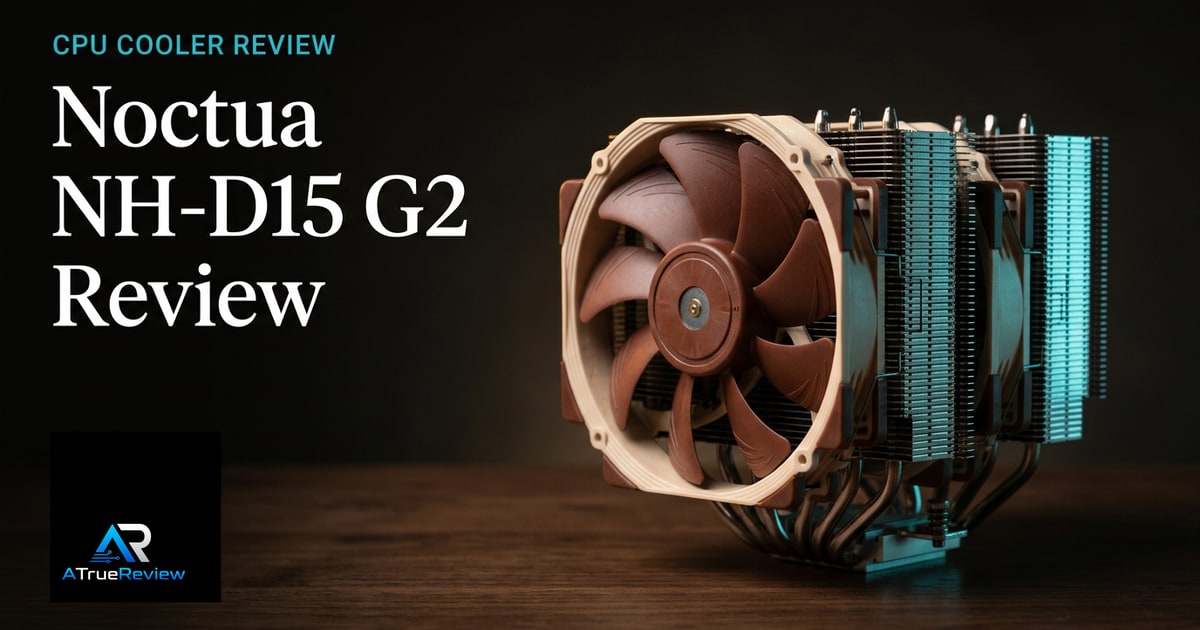
CPU cooler review
A review of the Noctua NH-D15 G2, focused on premium air-cooling performance, reliability, clearance tradeoffs, and whether the premium air approach is worth paying for.
Verdict
Recommended
The strongest current premium air-cooler candidate for builders who want high-end cooling without pump, radiator, or liquid-system complexity.

Best for
Builders with enough case clearance who want quiet high-end air cooling, long warranty support, and a simpler failure model than an AIO.
Skip if
Your case cannot handle a 168 mm tower, your RAM clearance is tight, you need maximum sustained cooling for extreme heat loads, or you want a final tested thermal/noise verdict before buying.
Test window
Launch brief based on Noctua product documentation. Hands-on thermal, acoustic, installation, RAM-clearance, and case-fit testing is still required before final scoring.
Specs
Key findings
The Noctua NH-D15 G2 is the rare premium PC component where the boring spec sheet is the entire pitch. It is a dual-tower air cooler with eight heatpipes, two 140 mm fans, and a six-year warranty — and the most interesting thing about it is that nothing about it is interesting. There is no pump to fail, no coolant to leak, no radiator to mount, and no software to update.
For most builders, that is the appeal. The G2 is not chasing the absolute thermal ceiling; it is chasing the highest performance that comes with the lowest set of things that can go wrong.
The strongest case is simplicity and reliability. Noctua’s official specifications list AM5, AM4, LGA1851, LGA1700, LGA1954, LGA1200, and LGA115x socket support — covering essentially every modern desktop platform. The package includes the NT-H2 thermal compound and Noctua’s SecuFirm2+ mounting system, which is one of the genuinely easy premium installations on the market.
The two NF-A14x25r G2 fans are the other half of the pitch. They are among the quietest 140 mm fans in production, and at idle or light load you simply will not hear the cooler. That is hard to say about most AIOs, which carry pump noise even when fans are still.
That is the real commercial question. The NH-D15 G2 does not need to top every thermal chart; it needs to justify why a builder should pay premium money for a large air tower instead of a cheaper cooler or a liquid loop.
If the buyer values long-term reliability, quiet operation, and the lowest probability of cooling-related downtime, the premium makes sense. If the build is modest, the case is tight, or the buyer only cares about maximizing benchmark thermals at all costs, the value case gets weaker quickly.
The NH-D15 G2 is physically large. At 168 mm tall, it blocks plenty of mid-tower cases, and the dual-tower footprint creates real RAM-clearance constraints with tall heatspreader kits. Noctua sells HBC (high build clearance) and LBC (low build clearance) variants to handle these edge cases, but the existence of three near-identical product names is itself a buyer-confusion problem.
You buy this cooler when you want the absolute lowest probability of cooling-related downtime, not when you want to win benchmark charts.
— The trade-off, in one line
At the extreme top of the CPU thermal envelope — sustained all-core workloads on the most power-hungry chips — a properly placed 360 mm AIO will pull ahead. If your build is a 24/7 rendering desk pushing a flagship CPU at unrestricted power limits, the NH-D15 G2 is enough but no longer best-in-class.
Before any final scoring, the site needs to test installation pressure on a real motherboard, RAM clearance with a typical tall-heatspreader DDR5 kit, noise-normalized thermals against a 360 mm AIO, idle and load fan noise, and whether the variant naming actually leads buyers to the right SKU.
The current air-cooler market has narrowed to two real choices at the premium tier: the NH-D15 G2 and the Arctic Liquid Freezer III on the AIO side. Below them sits the Thermalright Phantom Spirit 120 SE, which is the price-killer that gets most of the air-cooling job done for a fraction of the cost.
If absolute thermal performance under unrestricted-power flagship loads is the goal, the Arctic AIO wins. If quiet operation, simplicity, and long-term reliability matter more, the NH-D15 G2 wins. If price is the deciding factor, the Thermalright competes harder than the price gap suggests — but does not match the Noctua’s fan quality or warranty.
For shortlist context around that decision, the best CPU coolers guide shows where the NH-D15 G2 sits relative to AIO and quiet-tower alternatives, the cpu-coolers category narrows the thermal-only layer, and the wider computing hub helps buyers decide whether the real need is a better cooler, a better case airflow path, or a different build budget split. For builders pairing this with a high-end GPU and PSU, the RTX 5080 review and Corsair RM850x SHIFT review cover the rest of a clean modern build. The cooler choice should be made together with the case choice — see the Fractal North XL review for one chassis that clears the standard variant comfortably.
If you are building a high-end desktop and want the lowest-risk premium cooling solution, the NH-D15 G2 is the right answer. If your case has a tight cooler-height limit, the LBC variant is the right answer. If you are pushing a flagship CPU at unlimited power for sustained workloads and absolutely need to win the thermal benchmark, look at the Arctic AIO instead. If price-per-performance is the deciding factor, the Thermalright is the honest budget alternative.
The provisional verdict: still the safest premium air-cooling choice in the market, with reliability and noise advantages that benchmarks tend to under-credit. Final score depends on hands-on installation, clearance, and noise-normalized thermal testing.
Verdict shape
Pros
Cons
Alternatives
FAQ
Check the maximum CPU cooler height in your case spec. The standard NH-D15 G2 is 168 mm tall, which blocks many mid-tower cases. The LBC (low build clearance) variant trims height for tighter chassis. A roomy mid-tower or full-tower like the [Fractal North XL](/reviews/fractal-north-xl-review/) clears the standard version comfortably.
With low-profile RAM, no. With tall heatspreader RAM, the front fan must be raised, which costs you some height clearance. The HBC (high build clearance) variant handles taller RAM kits. Always check your motherboard's CPU socket area photo against the cooler's keep-out zone before buying.
Air is the lower-risk choice. No pump, no coolant loss, no radiator placement headache, and a longer service life. AIOs pull ahead only at the extreme top of CPU heat output, and only with a properly placed 360 mm radiator. For most modern AMD and Intel chips at mainstream voltages, the NH-D15 G2 is enough.
Standard for most builds. HBC if you have tall RAM and a roomy case. LBC if your case has a 168-mm-or-less cooler limit. Noctua's product page has a clearance chart; compare against your case spec before ordering.
The NF-A14x25r G2 fans are among the quietest 140 mm fans in production. At idle and light load you will not hear the cooler. Under sustained max load, you will hear the fan, but it remains quieter than most AIO pumps under the same conditions.
It is 168 mm in total height, so confirm case clearance before buying.
Intel LGA1851, LGA1700, LGA1200, LGA115x, and LGA1954, plus AMD AM5 and AM4, using the SecuFirm2+ mount.
Two 140 mm NF-A14x25r G2 PWM round-frame fans.
The Standard, HBC (high build clearance), and LBC (low build clearance) versions address different RAM and case clearance needs.