Best for
Who should buy it
Builders who want a large, attractive case with strong airflow intent, high-end GPU clearance, radiator flexibility, and a design that can sit in a living space.
 Our Method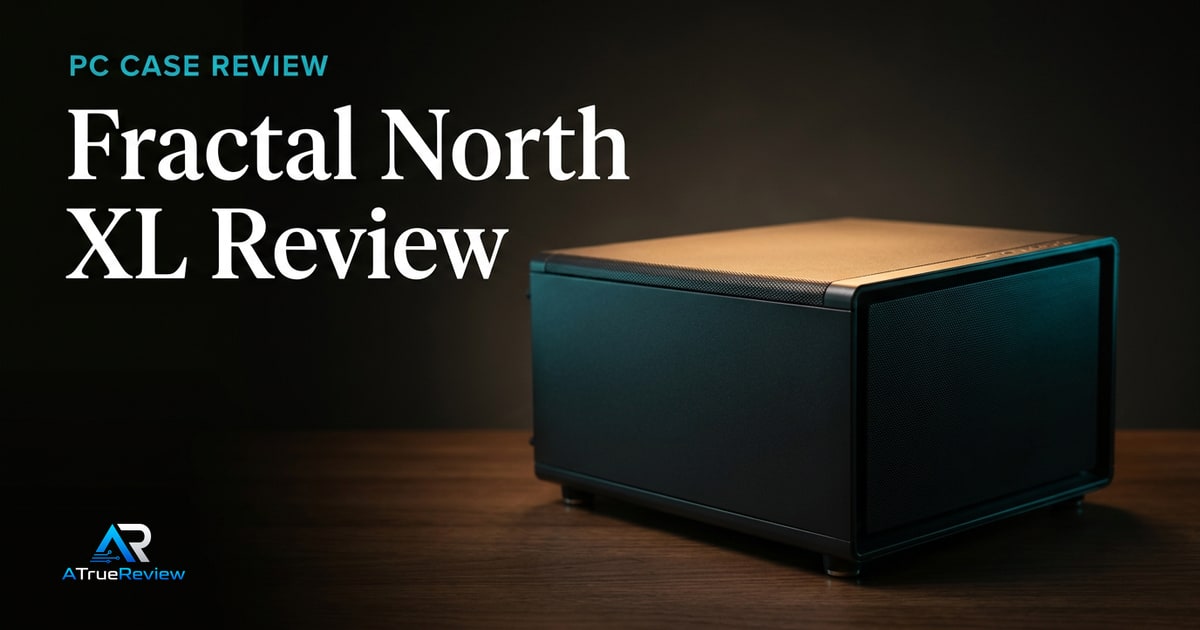
PC case review
A review of the Fractal North XL, focused on whether its wood-front design, large clearance envelope, and calmer room presence are worth paying for over a plain airflow box.
Verdict
Recommended
The strongest current style-forward case candidate for builders who want serious clearance without making the PC look like a lab appliance.

Best for
Builders who want a large, attractive case with strong airflow intent, high-end GPU clearance, radiator flexibility, and a design that can sit in a living space.
Skip if
You want the smallest possible ATX case, a budget airflow box, maximum acoustic dampening, or a final hands-on thermal/noise verdict before buying.
Test window
Launch brief based on Fractal Design product documentation. Hands-on build, cable-routing, thermal, dust, and noise testing is still required before final scoring.
Specs
Key findings
The Fractal North XL is the case that most cleanly resolves a tension PC building has carried for two decades: a serious gaming or creator desktop has to look like a lab appliance, with mesh, glass, and aggressive lighting that no living room has ever asked for. The North XL says no. The wood front bars, the restrained alloy details, and the mesh top mean the case can sit in a kitchen, an office, or a living-room console without explanation.
For many builders, that is finally the right answer. The previous generation of cases did not lose a thermal benchmark on purpose to look better — they just stopped pretending the build had to live in a server room.
The strongest argument is balance. Fractal’s official product page describes a larger form-factor design with FSC-certified oak or walnut front bars, alloy detailing, open front ventilation, mesh top panel, support for full E-ATX motherboards on TG and mesh variants, and three included 140 mm Aspect PWM fans. The included-fan story alone is worth several real dollars compared to most premium cases that ship with cheaper or fewer fans.
The clearance numbers are the other half of the pitch: GPU support up to 413 mm, or up to 380 mm with a 420 mm front radiator, plus front radiator support up to 420 mm and top radiator support up to 360 mm. The North XL can take the largest current air coolers, the largest current GPUs, and a serious AIO together — without the build feeling shoehorned.
For builders who want the case to look like furniture but still clear a 413 mm GPU and a 168 mm tower air cooler, the trade is unusually clean.
Case specs do not tell the whole story. A chassis can list the right radiator support and still be annoying if cable routing, fan noise, dust filters, side-panel access, drive mounts, or GPU clearance feel compromised in a real build.
A PC case is the only computer component that lives with the user every day in a way they look at. The North XL is the first major-brand chassis that took that seriously without trading away the build envelope.
— The honest framing
Two real risks deserve testing. First, the open front design favors airflow over acoustic dampening — a quiet case this is not. Builders who care most about silence over thermals should look elsewhere. Second, the tempered-glass side variant traps more dust than the mesh side variant; for a living-room placement where dust accumulation matters, mesh is the honest pick.
Before any final scoring, the site needs to test a high-end GPU build, an air-cooled build, a front-radiator build, cable routing behind the tray, dust-filter access, included fan behavior at multiple PWM curves, panel fit, and whether the wood-front design changes intake noise meaningfully under load.
Yes, when both parts of the pitch matter at the same time. The North XL earns its price when the builder wants a case that can clear a big GPU, a tall air cooler, or a large radiator without compromise, but also wants the machine to sit in a room like furniture instead of a convention prop.
It is not the right buy when only one half of that pitch matters. If the goal is the cheapest capable airflow box, there are easier answers. If the goal is the smallest possible ATX footprint, the XL’s size becomes a tax, not a benefit. The premium works when clearance, aesthetics, and room fit are all real constraints.
The premium-airflow-with-style segment has filled out: the standard Fractal North (smaller sibling), the Lian Li O11 Vision (glass-heavy showcase), and the be quiet! Silent Base 802 (acoustic-first). Each is a different philosophy:
For builders pairing this with a flagship GPU and modern PSU, the RTX 5080 review and Corsair RM850x SHIFT review cover the rest of the build envelope. The cooler choice typically pairs well with the NH-D15 G2, which the North XL clears comfortably.
If you are building a large, high-clearance gaming or creator desktop that needs to live in a shared room and you are willing to pay for the wood-and-alloy aesthetic, the North XL is the right case. If your build is smaller, save money and get the standard North instead — same look, smaller footprint. If acoustic performance is the priority, look at the Silent Base 802 or a similar dampened case. If you want maximum custom water-cooling theater, look at the Lian Li O11 Vision instead.
The provisional verdict: the cleanest large case on the market that does not look like a server. Final score depends on thermal, noise, and build-quality testing, but the design and clearance positioning is sound and unlikely to change. For shortlist context, route back through best PC cases, PC cases, or the wider computing hub.
Verdict shape
Pros
Cons
Alternatives
FAQ
Yes, comfortably. The North XL supports GPUs up to 413 mm, which clears every current partner-board RTX 5080 with margin. If you also install a 420 mm front radiator, the GPU clearance drops to 380 mm — still enough for most cards but check your specific board's length.
Yes, the standard NH-D15 G2 (168 mm tall) fits the North XL with comfortable clearance. The case is one of the friendliest current chassis for tall air coolers.
Mesh runs cooler and quieter under load. Glass looks better and shows the build off. Most readers will pick glass for the aesthetics; if maximum thermal performance is the goal, the mesh side variant is the right call.
Occasional. The wood bars themselves wipe clean with a dry microfiber cloth. The intake gaps between the bars are the actual filter — they catch dust and need a periodic vacuum or compressed-air sweep. Maintenance is no worse than a mesh-front case, just different.
Yes. The wood bars are spaced with intentional gaps; intake area is competitive with mesh-front cases. The wood is decorative; the airflow path is real. Reviewers who tested earlier North variants confirmed this; the XL inherits the same logic at a larger scale.
Up to 413 mm, or 380 mm with a 420 mm front radiator installed.
Up to 420 mm in the front and up to 360 mm on top.
ATX, microATX, and ITX, with E-ATX on the tempered-glass and mesh variants.
Three 140 mm Aspect PWM fans, with mesh top ventilation.
Up to six 3.5-inch drives plus multiple 2.5-inch drives.