Best for
Who should buy it
Samsung Galaxy phone owners who want passive sleep and recovery tracking on a ring without paying a monthly subscription.
 Our Method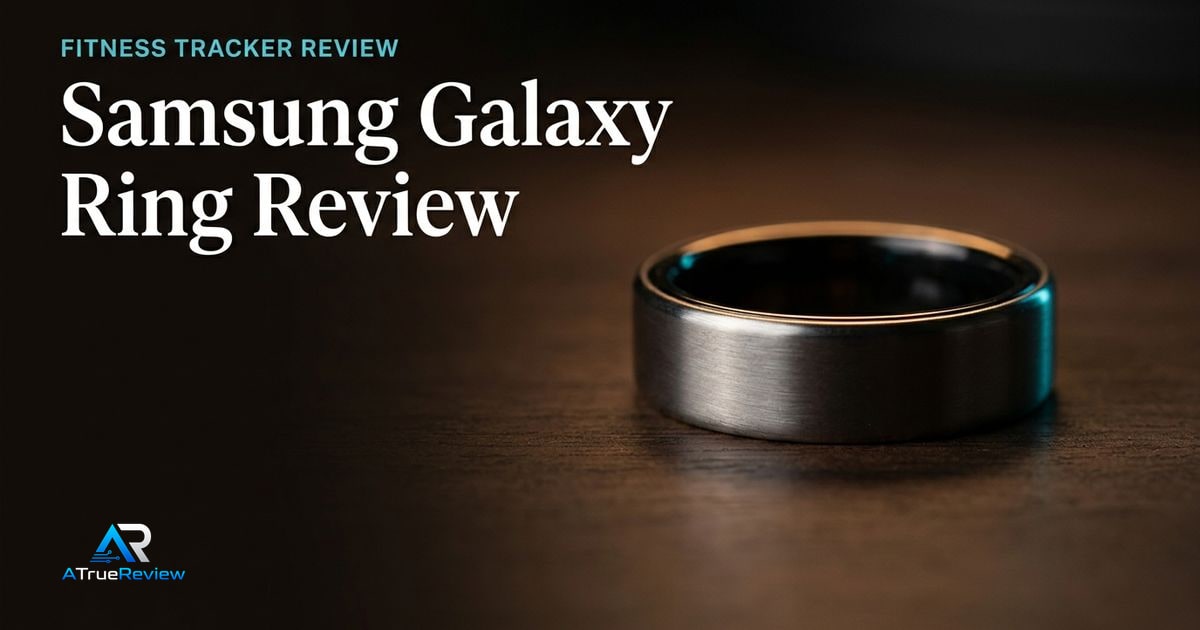
Wearable review
A review of Samsung Galaxy Ring as a no-subscription smart ring inside the Samsung Health ecosystem, focused on sensors, sizing, battery, Galaxy ecosystem dependency, and whether it can hold its own against Oura.
Verdict
Recommend with caveats
The strongest current no-subscription smart-ring recommendation — for Galaxy-phone owners. Outside the Samsung ecosystem, the proposition narrows fast.

Best for
Samsung Galaxy phone owners who want passive sleep and recovery tracking on a ring without paying a monthly subscription.
Skip if
You use an iPhone, you want the deepest sleep and recovery analytics in the category, or you do not already own a Galaxy Watch or Galaxy phone to anchor the ecosystem.
Test window
Launch brief based on Samsung product documentation and independent comparison reviews. Hands-on multi-week wear, sizing-accuracy, Samsung Health integration depth, and Energy Score actionability are still required before final scoring.
Specs
Key findings
The Samsung Galaxy Ring is the answer for buyers who want a smart ring without paying a subscription forever. That is the single sentence that decides the buying case. Everything else — the titanium build, the concave inner profile, the charging case that doubles as a battery bank — is supporting evidence for or against the core proposition.
It is also a deliberately Samsung product. The ring works best, and in most cases only works in a meaningful way, when there is a Galaxy phone in your pocket and a Galaxy Watch on your wrist. Outside that ecosystem, the value proposition narrows fast.
The hardware is the most-refined no-subscription smart ring on the market in 2026. Per Samsung’s official product page, the ring ships in nine sizes (5 through 13), three titanium finishes (Black, Silver, Gold), and three sensor types — an optical bio-signal sensor for heart rate, a skin-temperature sensor for overnight readings, and a 3-axis accelerometer for movement. The concave inner profile is genuinely different from Oura’s flatter band and, based on multi-week wear coverage from Wareable and Tom’s Guide, tends to disappear on the finger more readily than Oura Ring 4 for buyers with active hands.
Battery is the second hardware differentiator. Samsung claims up to 7 days on a single charge, extended to roughly 14 days when the clamshell charging case (which carries ~1.5 device charges of stored energy) is in the bag. Independent reviewers report real-world battery closer to 4–5 days under heavy use — still ahead of any wrist tracker, and meaningfully more practical than Oura’s stand-only charging puck when traveling.
The software side leans on Samsung Health, which has matured significantly across multiple Galaxy Watch generations. Energy Score is Samsung’s daily readiness signal — directionally similar to Oura Readiness or Whoop Recovery — but the deeper differentiation for Galaxy owners is sensor fusion: the ring’s nighttime data combines with the watch’s daytime workout data, and the watch can be controlled with ring gestures (camera shutter, calls). That is real ecosystem value, but only for the buyer who already has the watch.
Yes. The Samsung Galaxy Ring is the easy answer for one specific buyer profile: an Android-using, Samsung-Galaxy-phone-carrying reader who wants a no-subscription ring and is comfortable inside Samsung Health. For that buyer, this is the cleanest on-ramp.
For everyone else, the recommendation gets thinner:
Two real limitations matter for buying decisions.
A no-subscription ring is only a win if the platform behind it is good enough to keep paying attention to without a paywall pushing you. Samsung Health has to earn the attention; it cannot bill for it.
— The honest framing
First, ecosystem lock-in. The Galaxy Ring is sold as a Samsung accessory, not a cross-platform device. Buyers without a Galaxy phone should not buy it. Buyers with a Galaxy phone but no Galaxy Watch get a working product but miss the most distinctive sensor-fusion and gesture features.
Second, analytics ceiling. The Oura platform has a multi-year head start on sleep-stage detection, readiness scoring, and trend reporting. Samsung Health’s ring-specific layer is improving with each app update, but the depth gap is real. Buyers whose primary motivation is “what does my recovery look like over the past 60 days” still get a sharper read out of Oura.
Sizing is the third practical thing to get right. Smart rings only deliver clean sensor data when the fit is correct, and the Galaxy Ring’s 9-size range (5–13) is narrower than Oura’s 4–15. Use the sizing kit, wear samples for at least 24 hours, and err half a size larger if your fingers swell overnight.
Before any final scoring, the site needs to test multi-week wear comfort, real-world battery against the 7-day claim, Energy Score actionability across a real training block, Samsung Health sensor-fusion quality with a Galaxy Watch, sizing accuracy, and how the platform reads after the novelty fades.
Three real alternatives serve different buyers:
The Oura Ring 4 is the reference — deeper recovery and sleep analytics, wider 12-size range, full iOS and Android support, and a more refined editorial framing. The catch is the Oura Membership, which gates most of the meaningful insights and adds an ongoing cost.
The Ultrahuman Ring Air is the other major no-subscription smart-ring contender. Metabolism-and-glucose-adjacent positioning gives it a distinct angle for biohackers, broader iOS support than Galaxy Ring, and a comparable hardware story. See the Ultrahuman Ring Air review for the metabolism-focused alternative.
The Whoop 5.0 is the same recovery-and-sleep philosophy on the wrist — subscription-only, deeper strain coaching, more athlete-leaning. The right pick when the buyer wants a wrist-based device that integrates with cardio gear.
The Samsung Galaxy Ring wins when the buyer is already inside Samsung’s ecosystem and prioritizes no-subscription economics over absolute analytics depth.
For shortlist context around that decision, the best fitness trackers guide shows where Galaxy Ring sits relative to Oura and Whoop, the fitness-trackers category narrows the wearable-only layer, and the wider wearables hub helps buyers decide whether the right answer is a ring, a strap, a watch, or a broader sleep-and-recovery setup. For a complete recovery setup that pairs with the ring, the Eight Sleep Pod 4 review covers the bedroom-level upgrade; for a Samsung-adjacent phone that does not lock you into the ecosystem, the Nothing Phone 3 is the contrast pick.
If you own a Samsung Galaxy phone — ideally with a Galaxy Watch already on your wrist — and you want passive sleep and recovery tracking on a ring without paying a monthly fee, the Samsung Galaxy Ring is the right answer. If you use an iPhone, or if you want the most refined recovery analytics in the smart-ring category, the Oura Ring 4 is the honest alternative. If you want the same no-subscription model with metabolism-oriented framing, the Ultrahuman Ring Air is the contrast pick. If you want a wrist-based recovery device with deeper coaching, the Whoop 5.0 is the parallel option.
The provisional verdict: the strongest current no-subscription smart-ring recommendation for buyers already inside the Samsung ecosystem, contingent on multi-week wear validation, sizing accuracy, Samsung Health depth versus Oura, and whether the Energy Score stays useful past the novelty window. Final score depends on real-world wear and ecosystem-integration evaluation. For shortlist context, route back through best fitness trackers, fitness trackers, or the wider wearables hub.
Verdict shape
Pros
Cons
Alternatives
FAQ
Not in any meaningful way. Samsung Galaxy Ring requires a compatible Samsung Galaxy phone and Samsung Health to set up and to surface its insights. iPhone owners who want a ring should look at Oura Ring 4 or Ultrahuman Ring Air — both work cleanly on iOS.
Correct, as of 2026 — every feature Samsung advertises with the Galaxy Ring (Energy Score, sleep tracking, cycle tracking, recovery context) is unlocked at purchase and continues to work without a recurring fee. That is the single biggest differentiator vs Oura Ring 4, which requires the Oura Membership for most of the meaningful insights.
Samsung wins on no-subscription pricing, charging-case battery practicality, and Samsung-ecosystem integration; Oura wins on sleep-stage and recovery analytics depth, sizing range, and cross-platform support (iOS + Android). If you live inside Samsung, Galaxy Ring is the easier on-ramp. If you want the most refined recovery platform, Oura is still ahead. See the [Oura Ring 4 review](/reviews/oura-ring-4-review/) for the side-by-side.
Different form factor and different philosophy. Whoop is a wrist strap with subscription-only access to a deeper strain-and-recovery coaching layer; Galaxy Ring is a ring with no subscription and lighter analytics. Athletes who want the deepest daily score and accept the ongoing fee tend to prefer Whoop; readers who want passive data on a discreet device without paying forever tend to prefer the ring. The [Whoop 5.0 review](/reviews/whoop-5-review/) covers the strap side.
It is the most travel-friendly charging story in the category. The clamshell case holds roughly 1.5 full device charges, so a Galaxy Ring owner can leave home for a long weekend without a charger and stay topped up. Oura still ships a stand-only puck that needs an outlet; Whoop ships the PowerPack that clips to the band but does not have an internal reserve like the Samsung case.
Yes — like every smart ring. Samsung offers 9 sizes (5–13) and ships a sizing kit before the actual ring. Wear the sizing kit for 24 hours at the size you suspect; if your fingers swell at night or after meals, size up half a step. Sensor contact matters more than jewelry fit, so do not assume the size that matches your wedding ring is correct.
No, by design. There is no display, no notifications, no music control, no GPS. Samsung sells the Galaxy Ring as a complement to a Galaxy Watch, not a replacement — the ring handles 24/7 passive data while the watch handles in-workout instrumentation and notifications. If you have one device budget, pick a watch.
Up to 7 days on a single charge, extended to about 14 days with the clamshell charging case.
No. Every feature, including Energy Score, sleep tracking, and cycle tracking, is included and works in Samsung Health.
No. It is effectively Galaxy-only; full functionality requires a compatible Samsung Galaxy phone with Samsung Health.
US sizes 5 to 13 (9 sizes) in Titanium Black, Silver, and Gold; a sizing kit ships first.
Yes. It is rated 10 ATM and IP68, suitable for swimming and short submersion to about 100 m.