Best for
Who should buy it
Readers who like Nothing's design language and want a more distinctive Android phone than the Samsung, Google, or Apple default.
 Our Method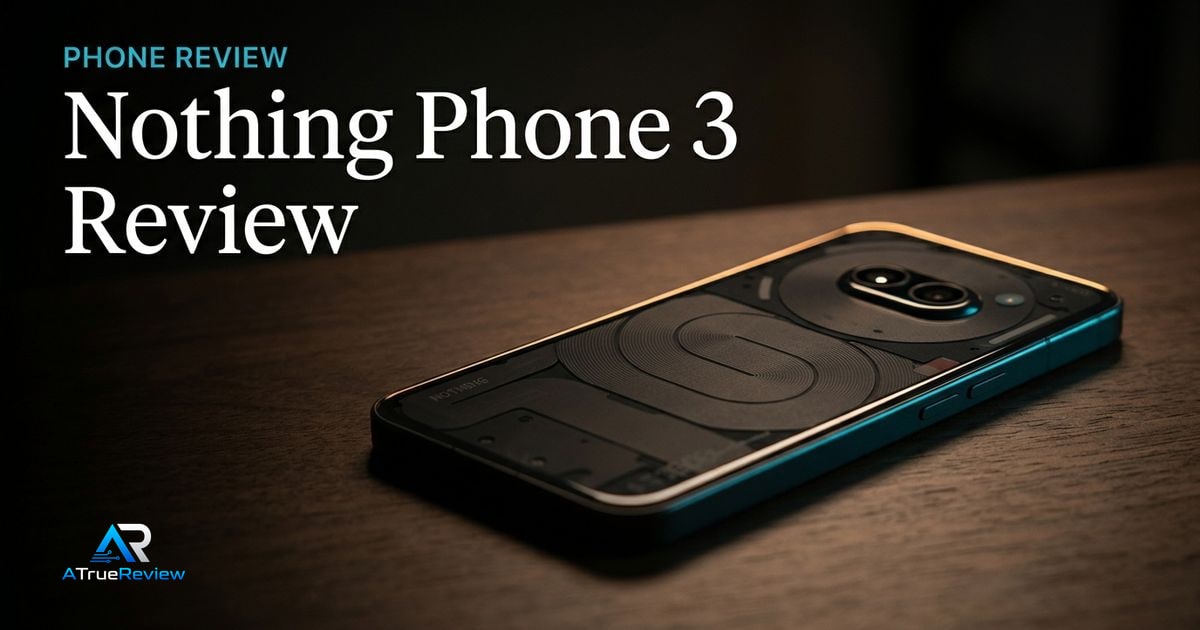
Smartphone review
A review of Nothing Phone 3, focused on whether its flagship-positioning risk, battery and charging claims, and design identity justify choosing personality over the safer defaults.
Verdict
Recommend with caveats
The personality-forward Android alternative, but not yet a safe top-three recommendation without direct camera, thermal, and software testing.

Best for
Readers who like Nothing's design language and want a more distinctive Android phone than the Samsung, Google, or Apple default.
Skip if
You need the safest flagship camera, the strongest ecosystem support, or a final hands-on recommendation.
Test window
Launch brief based on Nothing support documentation and current third-party review context. Hands-on retesting is still required before final scoring.
Specs
Key findings
The Nothing Phone 3 is interesting precisely because most flagship phones are not. Apple, Samsung, and Google have settled into refined, mature, very similar shapes; the differences live in software ecosystems and computational photography. Nothing offers something different — a transparent back, the Glyph Matrix on the rear panel, and a brand identity that says the phone is allowed to be a personality choice, not just a utility.
Whether that personality is worth the trade against more polished, longer-supported flagships is the actual review question. This launch brief takes it seriously without yet declaring a winner.
The strongest case is design identity. No other major-brand flagship looks like a Nothing Phone, and the Glyph Matrix is a genuine evolution from the original Phone 1’s LED strips — it can show notifications, timers, glance widgets, and minimal visual feedback in a way that feels distinct rather than gimmicky.
The hardware fundamentals are flagship-tier on paper. Nothing’s official support documentation lists a 5150 mAh battery (silicon-carbon chemistry) with full charge in roughly 60 minutes using the official charger. The display is a 120 Hz LTPO AMOLED with high peak brightness; the silicon is Snapdragon 8s Gen 4 with up to 16 GB of LPDDR5X RAM and UFS 4.0 storage; the camera array is three 50 MP sensors covering wide, ultrawide, and periscope telephoto.
That is the entire commercial question. Nothing Phone 3 does not need to beat the iPhone, Galaxy, and Pixel on every metric to be interesting. It needs to justify why a buyer should accept more uncertainty in exchange for a phone that feels more distinctive and less default.
If the buyer is bored by mainstream flagship design and genuinely cares about industrial design, brand voice, and a different ownership feel, the price starts to make sense. If the buyer mainly wants the safest camera, the longest support promise, or the least-risk ecosystem choice, the same money is easier to justify on a Pixel, Galaxy, or iPhone.
A distinctive phone can be commercially interesting without being the safest recommendation. TechRadar’s review frames Phone 3 as a bold step into flagship territory with a starting price that puts it directly against Pixel, Galaxy, and iPhone — exactly the comparisons where Nothing’s gaps matter most.
A flagship at flagship pricing has to compete on flagship terms — camera consistency, software longevity, and ecosystem fit. Personality is a tiebreaker, not a primary spec.
— The honest framing
Three risks deserve testing. First, camera consistency: Pixel and iPhone have years of computational photography refinement; Nothing has fewer years and a smaller dataset. Skin tones, low-light behavior, video stabilization, and HDR rendering are the categories where established players win. Second, software longevity: Nothing’s update commitment has improved but does not yet match Google’s seven-year Pixel commitment or Samsung’s seven-year Galaxy support. Third, North American carrier and network compatibility is narrower than Samsung or Apple — verify your specific carrier and plan before buying.
Before any final scoring, the site needs to test camera comparisons in good light and bad, low-light handling, video stabilization, thermal behavior under load, charging speed in real conditions, display readability outdoors, network performance on US carriers, update cadence over a six-month window, and whether the Glyph Matrix is genuinely useful after the first week.
The flagship segment in 2026 has narrowed to four real choices for most buyers:
The Google Pixel 10 Pro is the camera-first pick. Tensor silicon trails Snapdragon on raw performance, but Pixel computational photography remains the most consistent flagship camera experience for most users. Software support runs seven years.
The Samsung Galaxy S25 is the ecosystem-first Android pick. Snapdragon 8 Elite (in the US), broadest carrier compatibility, mature DeX desktop mode, seven-year update commitment, the largest accessory ecosystem.
The Apple iPhone 16 is the default for buyers in the Apple ecosystem — iMessage, FaceTime, AirDrop, AirPods, Apple Watch all work seamlessly together in a way no Android phone can match.
The Nothing Phone 3 is the alternative for buyers who find the above three boring. The hardware is competitive; the personality is unique; the trade is software polish and camera consistency.
For shortlist context around that decision, the best phones guide shows where Nothing sits against the safer flagship defaults, the smartphones category narrows the phone-only layer, and the wider phones hub helps buyers decide whether the real issue is the phone itself or the broader mobile stack. For readers building a wider personal-tech setup, the Framework Laptop 13 is the laptop counterpart to “owner-flexibility over default polish,” the Bose QuietComfort Ultra handles focus audio, and the Oura Ring 4 covers wearable health tracking without phone-brand lock-in.
If Nothing’s design language genuinely appeals to you and you are willing to accept the camera-and-software-polish trade against Pixel or iPhone, Phone 3 is the right answer in its niche. If camera consistency or longest-software-support is the deciding factor, the Pixel 10 Pro is the safer call. If you live in the Apple ecosystem, the iPhone 16 is the easier integration. If you need the broadest US carrier and accessory support, the Galaxy S25 is the safer Android pick.
The provisional verdict: a credible flagship-tier alternative for buyers who care about design identity, contingent on hands-on validation of camera, thermals, and software polish. Final score depends on multi-month real-world testing. For shortlist context, route back through best phones, smartphones, or the wider phones hub.
Verdict shape
Pros
Cons
Alternatives
FAQ
Hard to say without daily use. The Matrix is a clear evolution from the original Phone 1's LED strip — it can show notifications, timers, glance widgets, and small visual feedback. Whether that becomes genuinely useful or just a brand differentiator depends on the third-party app ecosystem and Nothing's own widget set. Treat it as a personality feature, not a productivity feature, until proven otherwise.
On paper, the triple 50 MP rear array covers the use cases. In practice, the question is consistency — skin tones, low light, video stabilization, HDR rendering. Pixel and iPhone have years of computational photography refinement. Nothing has fewer years and a smaller dataset. Treat the camera as "competent flagship" until cross-publication camera shootouts settle.
Verify before buying. Nothing's North American carrier compatibility has historically been narrower than Samsung or Apple. AT&T and T-Mobile generally work; some Verizon network features may require manual provisioning or simply not be supported. Check Nothing's current carrier compatibility list against your specific plan.
Nothing has committed to multi-year OS and security updates, but the exact policy has changed across launches. Verify the current commitment for Phone 3 specifically at purchase. As of the available reporting, Nothing does not yet match Google's 7-year Pixel commitment or Samsung's 7-year Galaxy commitment.
Both. The hardware is flagship-tier on paper. The buying argument is personality — distinctive design, transparent back, Glyph Matrix, brand identity. If you find the Pixel and Galaxy designs boring, this is the alternative. If you do not, the Pixel and Galaxy are the safer flagships with more polished software stacks.
It has a 5150 mAh silicon-carbon battery with 65 W wired and 15 W wireless charging; Nothing claims a full charge in about 60 minutes.
A Qualcomm Snapdragon 8s Gen 4, paired with 12 GB or 16 GB of LPDDR5X RAM and 256 GB or 512 GB of UFS 4.0 storage.
A triple 50 MP rear system (main, ultrawide, and periscope telephoto) plus a 50 MP front camera.
It carries an IP68 water and dust resistance rating.
A 6.67-inch AMOLED LTPO panel at 120 Hz with HDR10+ and a peak brightness Nothing claims exceeds 4500 nits.