Best for
Who should buy it
Biohacker-leaning buyers outside the US who want the lightest smart ring, no subscription, and the option to layer a CGM patch for metabolic data.
 Our Method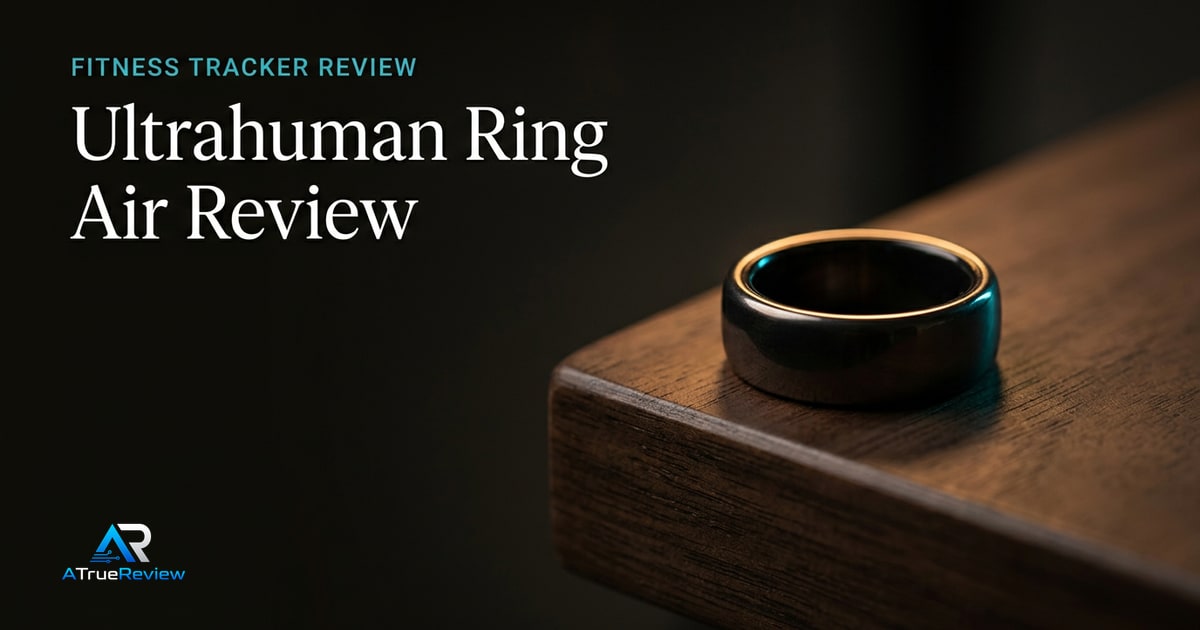
Wearable review
A review of Ultrahuman Ring Air as a no-subscription smart ring with metabolic-health positioning, focused on sensors, weight, battery, the M1 CGM integration, and the unresolved US patent dispute with Oura.
Verdict
Recommend with caveats
The most distinctive smart ring on the market in 2026 — featherlight, no recurring fee, and uniquely tied to a glucose monitor — but the recommendation depends on battery longevity validation and on US legal clearance.

Best for
Biohacker-leaning buyers outside the US who want the lightest smart ring, no subscription, and the option to layer a CGM patch for metabolic data.
Skip if
You are a US buyer who wants to be sure the product will stay legally available, you have a low tolerance for warranty risk after the 2026 battery-failure reports, or you want the deepest validated sleep-stage analytics in the category.
Test window
Launch brief based on Ultrahuman product documentation and independent launch and long-term coverage. Hands-on multi-week wear, battery longevity across multiple ring sizes, M1 patch integration validation, and resolution of the Oura patent dispute are still required before final scoring.
Specs
Key findings
The Ultrahuman Ring Air is the most distinctive smart ring on the market in 2026 and also the most complicated to recommend without caveats. The distinctiveness is real — it is the lightest ring in the major category, it has no required subscription, and it is the only smart ring that wires into a continuous glucose monitor through the Ultrahuman M1 patch. The complications are also real — owner reports of premature battery failures and an unresolved US patent dispute with Oura make the buying case look very different in the US than it does in Europe or Asia.
For the right buyer, the trade is genuinely worth taking. For the wrong buyer, the trade is needlessly risky when Oura and Samsung Galaxy Ring exist with cleaner stories.
The weight number is not marketing copy. Per Live Science’s hands-on coverage, the ring lands at 2.4–3.6 grams depending on size — meaningfully lighter than Oura Ring 4 (3.3–5.2 g) and lighter than Samsung Galaxy Ring (~3 g). On the finger, the difference matters most overnight; reviewers who sleep with their hand under their head consistently report Ultrahuman as the smart ring that disappears fastest. The titanium shell with tungsten-carbide carbon coating on the inside is also durable enough for showering, swimming, and sauna use.
The sensor stack is competitive with the rest of the category. An infrared PPG handles heart rate and blood oxygen, six-axis motion sensors handle movement and sleep detection, and a non-contact medical-grade skin-temperature sensor handles cycle and illness tracking. Battery life lands at up to 6 days, with full recharge in 2–3 hours — about the same window as Oura and slightly less than Samsung’s combined ring-plus-case story.
The no-subscription claim holds for the everyday user. Core sleep, recovery, HRV, movement, temperature, circadian rhythm coaching, and women’s hormonal insights all ship unlocked. Optional medical add-ons — AFib Detection at ~$4.90/mo, Cardio Adaptability at ~$2.90/mo — re-introduce a recurring fee for clinically-minded buyers, but the typical buyer never enables them.
The metabolic angle is the real differentiator nobody else in the category has. The Ultrahuman M1 is a separate 14-day continuous glucose monitor that you apply to the back of your upper arm. It pairs with the same Ultrahuman app the ring uses, and the cross-stream view — glucose curves on the same screen as sleep stages, HRV, and recovery — is genuinely useful for buyers who want to see how specific foods and training affect blood sugar. The catch is consumables: each M1 patch runs ~$150 and lasts ~14 days, so the pairing is most economical for short structured experiments rather than years of continuous wear.
Two real risks pull the confidence on this review down.
A featherlight, no-subscription, glucose-integrated smart ring sounds like the obvious answer until the battery quits at month four and the replacement queue stretches into weeks.
— The honest framing
First, the durability reports. Per WearableBeat’s 2026 long-term coverage and several long-term owner reviews surfaced this year, multiple buyers have flagged premature battery failures and bloating within months of regular use. Warranty exists, but replacement workflows have been reported as friction-heavy and slow. The story is not “all units fail” — plenty of long-term users are still wearing the original ring at month 18+ — but it is “the failure rate is high enough to weigh against a competitor with a cleaner record.” Oura, by comparison, has a multi-year track record of stable hardware across the consumer base.
Second, the US legal status. Per TechCrunch’s February 2026 coverage, Ultrahuman has been working through a patent dispute with Oura and a redesigned ring is being prepared for US-specific clearance. Before ordering from a US address, the buyer should check ultrahuman.com directly for current US shipping status — published reviewer reassurances from earlier in the dispute are not a substitute for the current legal availability. Buyers outside the US (UK, EU, India, Singapore, others) generally have not been affected.
There are softer caveats too. Sleep-stage and trend reporting are mature but still read as one step behind Oura’s editorial polish. The compelling metabolic story requires the M1 patch, which most buyers will not sustain past the first cycle or two. And the brand has a smaller retail and accessory footprint than Oura or Samsung — fewer in-store return paths, fewer band/case options, and a quieter community.
Before any final scoring, the site needs to test multi-week wear comfort, the 6-day battery against the headline number, sleep-stage accuracy against an Oura reference, the M1 patch experience over multiple cycles, US shipping availability at the time of testing, and how the ring stacks up at month six and twelve given the durability reports.
Three real alternatives serve different buyers:
The Oura Ring 4 is the reference and the safer US default — deeper analytics polish, wider sizing, broader retail support, and no patent-dispute overhead. Trade-off: the Oura Membership is required for most of the meaningful insights, the ring weighs more, and there is no metabolic-CGM layer in the same app.
The Samsung Galaxy Ring is the other major no-subscription option, with charging-case practicality and tight Samsung-ecosystem integration on Galaxy phones. Trade-off: iPhone owners lose almost the entire experience, sensor-fusion features depend on owning a Galaxy Watch, and there is no glucose-monitor pairing.
The Whoop 5.0 is the strap-based recovery alternative — deeper strain-and-recovery coaching, subscription-only, more athlete-leaning. The right pick for buyers who want a wrist-based instrument that integrates with cardio gear.
The Ultrahuman Ring Air wins when the buyer is outside the US, prioritizes ring weight, wants the metabolic angle through the M1 patch, and accepts the warranty risk in exchange for the no-subscription economics.
For shortlist context around that decision, the best fitness trackers guide shows where Ultrahuman sits relative to Oura and Samsung, the fitness-trackers category narrows the wearable-only layer, and the wider wearables hub helps buyers decide whether the right answer is a ring, a strap, a watch, or a broader sleep-and-recovery setup. For a complete recovery setup that pairs with the ring, the Eight Sleep Pod 4 review covers the bedroom-level upgrade.
If you are outside the US, prioritize ring weight, want a no-subscription smart ring, and want the option to add a continuous glucose monitor through the same app, the Ultrahuman Ring Air is the most distinctive choice on the market — and the right one for that buyer profile. If you are a US-based buyer who values warranty cleanliness over feature distinctiveness, the Oura Ring 4 is the honest safer default. If you live in the Samsung ecosystem and want no-subscription economics without the patent-dispute overhead, the Samsung Galaxy Ring is the cleaner pick. If a wrist strap suits your daily wear better than a ring, the Whoop 5.0 is the parallel recovery option.
The provisional verdict: the most distinctive smart-ring recommendation in 2026 for the right buyer, contingent on multi-week wear validation, M1 CGM cycle experience, US legal-availability resolution, and battery longevity holding past the failure-rate window. Final score depends on real-world wear and warranty-experience evaluation. For shortlist context, route back through best fitness trackers, fitness trackers, or the wider wearables hub.
Verdict shape
Pros
Cons
Alternatives
FAQ
Status is contingent on the Oura patent dispute and pending US clearance. As of early 2026, US availability has been complicated and Ultrahuman has been working on a redesigned version specifically to clear regulatory hurdles. Before ordering from a US address, check Ultrahuman.com directly for current shipping status — verbal "yes" from a reviewer six months ago does not equal current legal availability.
For the core experience, yes — sleep tracking, recovery scoring, HRV, movement, temperature, circadian rhythm coaching, and women's hormonal insights all ship unlocked for the life of the ring. Two clinical add-ons (AFib Detection at ~$4.90/mo, Cardio Adaptability at ~$2.90/mo) are subscription-based, and the M1 CGM patch is sold separately. The headline "no subscription" claim is accurate for the everyday user.
The Ultrahuman M1 is a separate 14-day continuous glucose monitoring patch you apply to the back of your upper arm. It pairs with the same Ultrahuman app the ring uses, so glucose readings are correlated with sleep, heart rate, and HRV in one place. The unique value is seeing how individual foods, training, and sleep affect blood sugar — most consumer wearables cannot show that. The catch is cost (~$150 per 14-day patch) and consumable supply.
Different positioning. Oura wins on editorial polish, clinical-validation depth, sizing range (4–15 vs 5–14), broader retail support, and unambiguous US availability. Ultrahuman wins on weight (lightest in category), no required subscription, and the M1 metabolic integration that Oura cannot match. Buyers chasing glucose-and-sleep correlation lean Ultrahuman; buyers who want the most refined consumer recovery platform lean Oura. See the [Oura Ring 4 review](/reviews/oura-ring-4-review/) for the side-by-side.
Both are no-subscription smart rings. Galaxy Ring wins for Samsung Galaxy phone owners — sensor fusion with Galaxy Watch, gesture control, charging-case battery. Ultrahuman wins for iPhone users, biohackers wanting CGM correlation, and buyers who prioritize ring weight. Outside the Galaxy ecosystem, Ultrahuman is the more open option. The [Samsung Galaxy Ring review](/reviews/samsung-galaxy-ring-review/) covers the ecosystem-lock side.
They are real and worth weighing. Multiple 2026 long-term review pieces flag premature battery degradation and bloating within months of regular use, and the replacement workflow has been reported as slower than expected. The official warranty covers manufacturing defects, but the friction in claim handling has reduced confidence among repeat owners. If warranty risk matters more than the metabolic angle, Oura or Samsung is the safer pick today.
Only if you will actually use the glucose data to change diet, training, or sleep behavior. The first two weeks of CGM readings are educational for almost anyone — most people are surprised by how specific foods spike them. Beyond that, the cost per patch (~$150) only makes sense if you are running structured nutrition experiments, managing pre-diabetes, or coaching others on metabolic health. Casual wearers can skip the patch and still get the core ring value.
2.4 to 3.6 g depending on size, the lightest in the major smart-ring category, in a titanium shell.
Up to 6 days, with a full charge in 2 to 3 hours on the included stand.
No for the core experience. Optional medical add-ons are AFib Detection (about $4.90/mo) and Cardio Adaptability (about $2.90/mo).
An infrared PPG for heart rate and blood oxygen, 6-axis motion sensors, and a non-contact medical-grade skin-temperature sensor.
It is IPX8-rated for shower, pool, and water sports, but not deep diving.