Best for
Who should buy it
Serious recovery-focused athletes, chronic-soreness operators, and remote-work knowledge workers who want one device that combines percussion, red-light, and heat therapy in a daily-use form factor.
 Our Method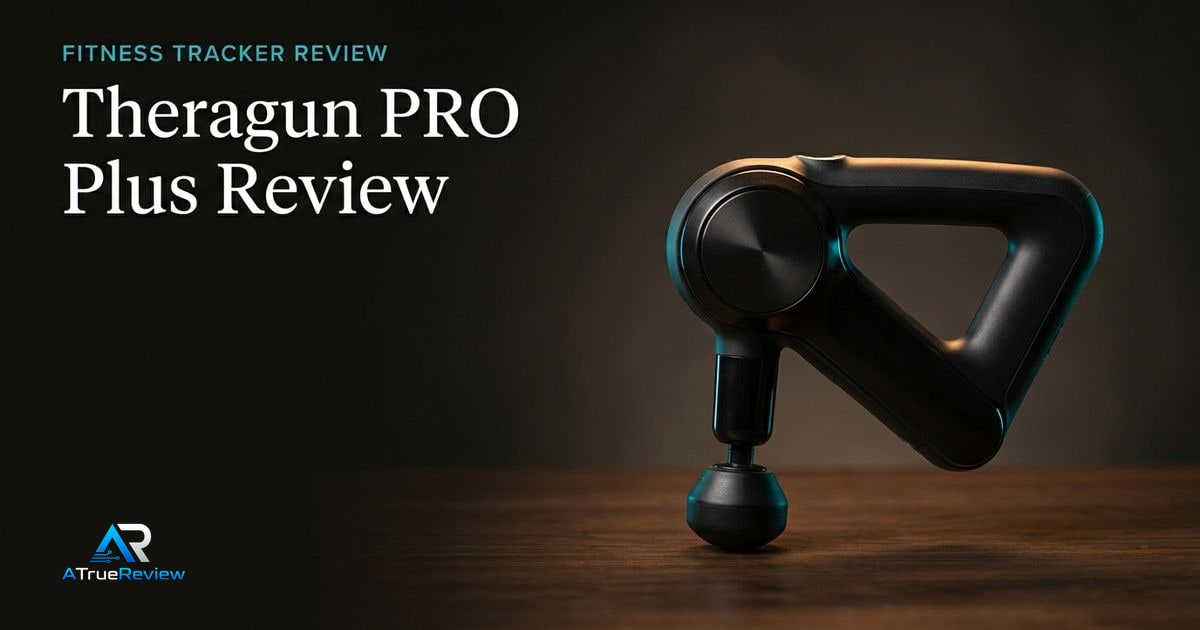
Recovery review
A review of Therabody Theragun PRO Plus as a multi-therapy recovery device, focused on percussion, near-infrared LED red-light therapy, heat, vibration, breathwork, heart-rate sensing, and whether the kitchen-sink approach earns the $599 premium over a standard Theragun.
Verdict
Recommend with caveats
The most complete recovery device Therabody has shipped — and the right pick for buyers who will genuinely use the multi-therapy stack rather than treat it as an expensive percussion massager.

Best for
Serious recovery-focused athletes, chronic-soreness operators, and remote-work knowledge workers who want one device that combines percussion, red-light, and heat therapy in a daily-use form factor.
Skip if
You only need percussion (cheaper Theragun Prime / Elite covers it), you already own a separate red-light panel, or the $599 price does not map to a real recovery routine.
Test window
Launch brief based on Therabody product documentation and independent post-launch coverage. Hands-on multi-week use, near-IR LED red-light efficacy validation, heat layer comfort under daily use, breathwork program engagement, app integration reliability, and battery life against the 150-minute claim are still required before final scoring.
Specs
Key findings
The Therabody Theragun PRO Plus is what happens when Therabody stops asking “what is the next iteration of our massage gun?” and starts asking “what is the most-loaded recovery device we can ship in this form factor?” The result is unusual in the category — five different recovery therapies (deep-muscle percussion, near-infrared LED red-light, heat, vibration, breathwork) in one handheld device, with a built-in optical heart-rate sensor that ties session pacing to measured HRV through the Therabody app.
It is also the priciest Theragun ever, at $599 MSRP. The question is not whether the multi-therapy layer is genuine — it is, technically — but whether a specific buyer will actually use enough of it to justify $300–$400 more than a Theragun Elite or a Hypervolt 2 Pro. For the right recovery-focused buyer, yes. For most buyers, no.
The percussion layer is still the foundation, and it remains category-leading. Per T3’s review, the PRO Plus ships with Therabody’s Gen-5 brushless motor delivering up to 16 mm amplitude — the deepest amplitude in the consumer category, the spec that makes a difference on dense muscle groups (glutes, quadriceps, traps). The rotating arm geometry continues to be the differentiator: hard-to-reach areas like the upper back and lats are genuinely treatable without contortion in ways simpler T-handle massage guns cannot match.
The near-infrared LED red-light therapy is the headline new layer. Per Therabody’s product documentation, the LED head illuminates a 100 cm² treatment area at 40 mW/cm² power density, delivering roughly 360 J in 90 seconds per muscle group. These specs sit comfortably in the range independent red-light-therapy research uses for circulation and post-exercise recovery effects — which makes the LED layer a genuine feature rather than a marketing checkbox.
The Gen-5 motor is also meaningfully quieter than the previous PRO generation. Long-term reviewers report that the device is usable during phone meetings at moderate intensities — a real lifestyle upgrade for remote-work knowledge workers who want recovery integrated into the workday rather than scheduled around it.
The Therabody app integration is the quiet final layer. Daily recovery routines, breathwork sessions synchronized to measured HRV from the built-in heart-rate sensor, and post-workout protocols give the device a software cadence that one-off percussion guns lack.
For most Theragun Elite or Theragun Prime owners, only conditionally. The percussion performance has been refined but not transformed — the previous Theragun PRO is still an excellent percussion device, and the Elite covers most of the same percussion spec at a lower price. The case for upgrade is the multi-therapy layer: near-IR LED red-light, heat, breathwork, and the HR-sensor integration. Buyers who would otherwise buy a separate red-light panel or a separate heated massage tool may find the PRO Plus consolidates the kit usefully.
For first-time Theragun buyers who specifically want a comprehensive multi-therapy recovery device, the PRO Plus is the right entry point — assuming the budget and the routine are both real.
Two real limitations matter for buying decisions.
A $599 multi-therapy device only earns its price when used as a multi-therapy device. The cheaper percussion-only Theragun is the smarter buy for most users.
— The honest framing
First, the price-to-routine mismatch. Per Massage Gun Advice’s review, the PRO Plus is meaningfully more capable than the Theragun Elite ($299) — but only if the buyer will use the additional capability. Many owners revert to using PRO Plus as an expensive percussion gun within weeks of purchase, at which point the Elite, the Theragun Prime ($199), or the Hypervolt 2 Pro covers the same use case for half the cost. Before buying, audit your real recovery routine, not your aspirational one.
Second, the cold-therapy gap. The PRO Plus does not bundle the cold-therapy head attachment — that is a separate ~$100 purchase. Buyers who want cold as part of the kit should expect to add it; buyers who already have an ice bath, a cold plunge, or separate cryotherapy hardware can leave the attachment off.
There are softer caveats too. At 1,650 g, the PRO Plus is heavier than the Elite and Prime, which matters during longer self-massage sessions on harder-to-reach muscle groups. The 100 cm² LED treatment area is genuinely useful for targeted muscle work but does not replace a full-body red-light therapy panel for buyers who want whole-skin coverage. And the device’s HR / HRV data does not export to Apple Health or Google Health Connect, which limits its standalone value outside the Therabody app.
Before any final scoring, the site needs to test multi-week wear and tear, near-IR LED red-light efficacy validation across a real recovery routine, heat layer comfort under daily use, breathwork program engagement reliability, app integration stability across firmware updates, percussion comparison against the Theragun Elite and Hypervolt 2 Pro on identical muscle groups, and battery life against the 150-minute claim.
Three real alternatives serve different buyers:
The Theragun Elite (3rd-gen Pro) is the percussion-focused alternative at $299 — same Gen-5 motor lineage, similar 16 mm amplitude, none of the LED / heat / breathwork stack. The right pick for buyers who only need percussion.
The Hypervolt 2 Pro is Hyperice’s flagship percussion device at ~$299 — similar percussion specs, Bluetooth app integration, broader retail availability, no LED red-light or heat layer. The right cross-shop on price-conscious percussion-only buying decisions.
The Oura Ring 4 is the complementary passive recovery instrument — Oura tracks 24/7 readiness and sleep; PRO Plus delivers the active treatment. The right combination for buyers who want both the measurement layer and the intervention layer.
The Theragun PRO Plus wins when the buyer will genuinely use the multi-therapy stack — percussion, LED red-light, heat, breathwork, HR-sensor-driven session pacing — as part of a real recovery routine, not just as percussion.
For shortlist context around that decision, the best fitness trackers guide shows where the PRO Plus sits relative to wearable recovery instruments, the fitness-trackers category narrows the wearable-only layer, and the wider wearables hub helps buyers decide whether the right answer is a recovery device, a wearable, or a broader sleep-and-recovery setup. For a complete recovery setup that pairs with the PRO Plus, the Eight Sleep Pod 4 review covers the bedroom-level upgrade; for the workout-instrumentation side, the Garmin Forerunner 965 review covers the structured-training watch that pairs cleanly with active recovery devices.
If you are a serious recovery-focused athlete, chronic-soreness operator, or remote-work knowledge worker who will genuinely use percussion, near-IR LED red-light therapy, heat, breathwork, and HR-driven session pacing as part of a real recovery routine, the Theragun PRO Plus is the most complete current pick. If you only need percussion, the Theragun Elite at $299 covers it. If you want broader cross-shopping on price, the Hypervolt 2 Pro is the percussion-only alternative. For passive recovery scoring that pairs with the device, the Oura Ring 4 or Whoop 5.0 is the right wearable layer.
The provisional verdict: the strongest current multi-therapy recovery device recommendation for buyers who will use the full stack, contingent on multi-week routine validation, near-IR LED red-light efficacy across a real recovery cycle, heat-layer comfort under daily use, breathwork engagement reliability, and percussion comparison against the Theragun Elite and Hypervolt 2 Pro on identical muscle groups. Final score depends on real-world wear and recovery-routine evaluation. For shortlist context, route back through best fitness trackers, fitness trackers, or the wider wearables hub.
Verdict shape
Pros
Cons
Alternatives
FAQ
Specs say yes — 40 mW/cm² power density over 100 cm² delivering ~360 J in roughly 90 seconds per muscle group is in the range that independent red-light-therapy research uses for circulation and recovery effects. The catch is consistency. Single sessions produce little measurable effect; multi-week daily use is where the literature shows results. The PRO Plus is genuinely usable as a targeted red-light device for specific muscle groups; it does not replace a full-body panel for buyers who want whole-body skin-level coverage.
Depends on use case. The Theragun Elite ($299) covers the same percussion performance — 16 mm amplitude, similar motor lineage — without the LED / heat / breathwork stack. The Theragun Prime ($199) covers percussion with a smaller amplitude and simpler controls. The PRO Plus only earns the $300–$400 premium over Elite if the buyer will genuinely use the LED red-light, heat, and breathwork layers as part of a real recovery routine. If you would use it primarily as a percussion gun, buy Elite and put the savings elsewhere.
Hypervolt 2 Pro is Therabody's primary percussion-only competitor — similar amplitude, similar quiet motor, Bluetooth app integration, lower price (~$299). Neither has the LED / heat / breathwork stack. Buyers choosing on percussion alone often pick Hypervolt for the price; buyers choosing on the multi-therapy layer pick PRO Plus. Both have similar percussion performance in independent reviews.
It is most useful in two scenarios. First, breathwork programs through the Therabody app — the sensor synchronizes session pacing to measured HRV, which is more engaging than passive guided audio. Second, the app uses session HR / HRV to recommend follow-on routines (lighter percussion on high-stress days, deeper work on recovered days). Outside the Therabody app, the sensor data does not export to Apple Health or Google Health Connect, which limits its standalone value.
Cleanly. Buyers commonly wear an [Oura Ring 4](/reviews/oura-ring-4-review/) or [Whoop 5.0](/reviews/whoop-5-review/) for passive 24/7 recovery scoring and use the PRO Plus for active treatment when the readiness score is low. Therabody is in the process of expanding its app integrations, but as of 2026, the integration is informational — the wearable does not directly trigger PRO Plus sessions.
The Gen-5 motor is meaningfully quieter than the previous Theragun PRO — quiet enough to use during a phone call at normal volume without the other party noticing if you stay on a lower percussion setting. At maximum amplitude and frequency, the device is still audible but no longer disruptive in a shared room. The vibration mode (without percussion) is essentially silent.
Conditionally. The cold-therapy head adds true cryotherapy capability to the device — useful for post-workout inflammation and acute injury management. For buyers who already have an ice bath, a cold plunge, or a separate cryotherapy device, the attachment is redundant. For buyers who want one device to cover percussion, LED, heat, and cold across a unified app and form factor, it completes the kit. The attachment is a separate ~$100 purchase.
Five: percussive massage, near-infrared red-light therapy, heat therapy, vibration therapy, and guided breathwork through the app.
About 1,650 g without attachments, listing at $599 in the US (£549 / AU$899).
Up to about 150 minutes per charge, via the included USB-C cable.
Up to 16 mm amplitude and up to 30 lb of stall force from the QX150 brushless motor.
A near-IR LED head treats a 100 cm2 area at 40 mW/cm2, delivering about 360 J in roughly 90 seconds per muscle group.