Best for
Who should buy it
Competitive PC and console players who want a closed-back wireless headset built around low latency, voice clarity, ANC, and FPS-focused tuning.
 Our Method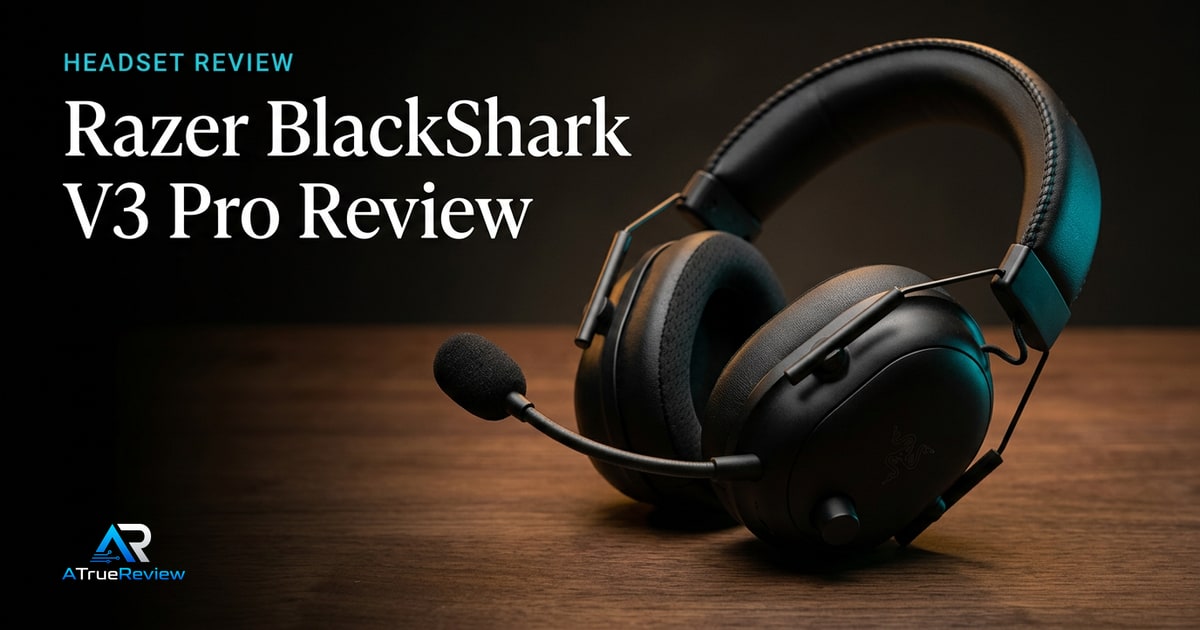
Gaming headset review
A review of the Razer BlackShark V3 Pro, focused on whether its esports latency claims, ANC, full-band mic, and platform-specific models are worth paying for in a real setup.
Verdict
Recommended
The strongest current Razer esports-headset candidate on paper, pending direct latency, mic, ANC, comfort, battery, and platform testing.

Best for
Competitive PC and console players who want a closed-back wireless headset built around low latency, voice clarity, ANC, and FPS-focused tuning.
Skip if
You want a lighter casual headset, open-back staging, audiophile tuning, a cheaper wired option, or a final tested verdict before buying.
Test window
Launch brief based on Razer product documentation and launch materials. Hands-on latency, microphone, ANC, comfort, and game-audio testing is still required before final scoring.
Specs
Key findings
The Razer BlackShark V3 Pro is the current Razer answer to a specific question: what should a competitive PC or console gamer buy if they want a wireless headset that takes the FPS use case seriously? The headline answers — HyperSpeed Wireless Gen-2 at claimed 10 ms latency, hybrid ANC, a detachable 12 mm 48 kHz mic, and THX Spatial Audio on PC — describe a product that is not chasing audiophile staging or maximum battery life. It is chasing positional clarity, voice quality, and competitive responsiveness.
Whether it earns the segment lead depends on hands-on testing of mic rejection, ANC usefulness, comfort over multi-hour sessions, and whether the platform-specific SKUs create more friction than the platform-specific tuning is worth.
The strongest case is competitive focus. Razer’s launch announcement frames the BlackShark V3 Pro lineup as platform-optimized for PC, PlayStation, and Xbox, built around HyperSpeed Wireless Gen-2 with claimed 10 ms latency, hybrid ANC, a detachable 12 mm 48 kHz full-band microphone, Gen-2 TriForce 50 mm bio-cellulose drivers, THX Spatial Audio on PC, and simultaneous 2.4 GHz plus Bluetooth.
Three of those features genuinely matter for the target buyer. First, low-latency wireless: a competitive headset can sound exciting and still fail if footstep cues, reload audio, or teammate callouts blur or arrive late. Razer’s number is competitive with the best wireless gaming dongles. Second, the mic spec: a detachable 12 mm 48 kHz full-band mic is unusually good on paper — voice clarity matters more in team games than bass impact. Third, simultaneous 2.4 GHz + Bluetooth: take a phone call without leaving the game, mix Discord audio cleanly.
For PC builders pairing this with a current GPU and other gaming gear, the headset is independent of the build — see the RTX 5080 review for the GPU side and the Razer DeathAdder V4 Pro review for a same-brand mouse pairing.
Three big unknowns deserve testing before any final score: platform-variant complexity, comfort, and ANC tuning.
A platform-locked headset is twice as good when you commit to one platform — and twice as confusing when you don’t.
— The honest framing
The platform-specific SKU strategy is the largest practical concern. PC, PlayStation, and Xbox versions exist with different wireless stacks. A buyer who plays across platforms either buys the PC variant and accepts the 3.5 mm fallback for console use, or buys multiple headsets — neither is ideal. Razer’s variant naming on retail pages can also be inconsistent; verify which SKU you are actually buying.
Closed-back ANC headsets get warmer than open-back gaming headsets over long sessions; the Razer software stack (Synapse) has historically been heavyweight and occasionally unreliable; and battery life trails the longest wireless gaming headsets — exact figures depend on the variant and listening modes.
Before any final scoring, the site needs to test mic clarity in real Discord and game-voice scenarios, ANC effectiveness against keyboard and fan noise, clamp force and heat over four-hour sessions, simultaneous Bluetooth-and-2.4 GHz behavior, battery drain across mixed use, and whether the platform-specific feature differences are meaningful in practice.
Usually yes, but only when competitive use is the reason for the purchase. The BlackShark V3 Pro earns its premium when the buyer wants low-latency wireless, a genuinely useful boom mic, and ANC that helps in shared spaces or streaming setups, and when one primary platform defines the buying decision.
It is not worth paying extra just to own the top SKU. If the buyer mostly wants one easy wireless headset for casual play, music, and device hopping, the platform-specific model split and premium feature set become more friction than advantage.
The premium wireless gaming headset segment has narrowed to a few clear choices:
The SteelSeries Arctis Nova Pro Wireless is the feature-stack pick — multi-source mixer base station, hot-swappable batteries, robust mic. Different priorities: less focused on raw latency, more on workflow flexibility.
The Logitech G Pro X 2 Lightspeed is the lighter, simpler, and often cheaper alternative. Slightly more neutral tuning, fewer features, simpler platform story. The right answer for buyers who want the basics done well without ANC or hybrid Bluetooth.
The Razer BlackShark V2 Pro (previous generation) covers the same competitive-FPS use case without ANC or hybrid Bluetooth, often at a meaningful discount. The honest pick for buyers who don’t specifically need the new features.
The BlackShark V3 Pro wins when low-latency wireless, mic quality, and ANC for streaming or shared spaces all matter — and when you primarily play on one platform.
For non-gaming audio (music, travel, focus calls), the Bose QuietComfort Ultra is a different product entirely — the BlackShark is not a music-and-travel headphone, and the QuietComfort Ultra is not a competitive gaming headset.
If you are a competitive PC or console player who wants a wireless gaming headset built around latency, voice clarity, ANC, and FPS-focused tuning, the BlackShark V3 Pro is the right tier — pick the variant that matches your primary platform. If you want a simpler, lighter, cheaper wireless gaming headset without ANC or Bluetooth, the Logitech G Pro X 2 Lightspeed is the honest alternative. If you want a multi-source mixer base and swappable batteries, the SteelSeries Arctis Nova Pro Wireless is the different-priorities pick.
The provisional verdict: the strongest current Razer esports headset on paper for the one-platform competitive buyer, contingent on hands-on validation of mic, ANC, latency, and platform-specific behavior. Final score depends on real-game testing across at least one tactical shooter and one louder action title. For shortlist context, route back through best gaming headsets, gaming headsets, or the wider audio hub.
Verdict shape
Pros
Cons
Alternatives
FAQ
Buy the one that matches your primary platform. The PC version uses HyperSpeed Wireless Gen-2 with THX Spatial Audio. The PlayStation variant integrates with the PS5's audio stack. The Xbox variant supports Xbox Wireless. Cross-platform use is possible via the 3.5 mm analog fallback (where supported), but the wireless feature set is platform-locked. If you split time between PC and console, the PC variant plus a wired connection to console is the most flexible compromise.
Razer's number is the wireless link latency, not end-to-end (game engine + audio mixer + driver + headset). End-to-end latency is always higher and depends on the game and the platform. That said, 10 ms wireless is at the front of the segment — competitive with the best wired headsets in practice for everything except the most latency-sensitive professional esports use cases.
Useful. ANC blocks the keyboard, mouse, fan noise, and household ambience that closed-back gaming headsets only partly muffle. For streamers, ANC means less ambient noise leaking into the live mix. For shared-living-room gaming, ANC means partner-and-roommate tolerance. The Bose-class travel ANC is overkill for gaming; the BlackShark's hybrid approach is better-suited.
Yes — the PC variant's HyperSpeed Wireless Gen-2 dongle plugs into any free USB port. THX Spatial Audio runs in software and is GPU-agnostic. The headset is independent of your GPU choice; nothing about the BlackShark V3 Pro is RTX-specific.
Different products. The Bose is a music-and-travel headphone with stronger comfort and music tuning. The BlackShark is a gaming headset with strong call/mic and gaming positional audio. If you want one headphone for everything (music, travel, calls, occasional gaming), buy the Bose. If you want competitive gaming as the primary use case and music as a secondary, buy the BlackShark.
HyperSpeed Wireless Gen-2 (2.4 GHz dongle) with simultaneous Bluetooth, plus a 3.5 mm wired fallback on some variants.
Yes, hybrid active noise cancellation, a first for the BlackShark flagship line.
Gen-2 50 mm TriForce bio-cellulose drivers and a detachable 12 mm 48 kHz full-band microphone.
Razer claims latency as low as 10 ms over HyperSpeed Wireless Gen-2.
Yes, separate PC, PlayStation, and Xbox-optimized models; THX Spatial Audio is available on PC.