Best for
Who should buy it
Frequent travelers, office listeners, and people who wear headphones for long stretches.
 Our Method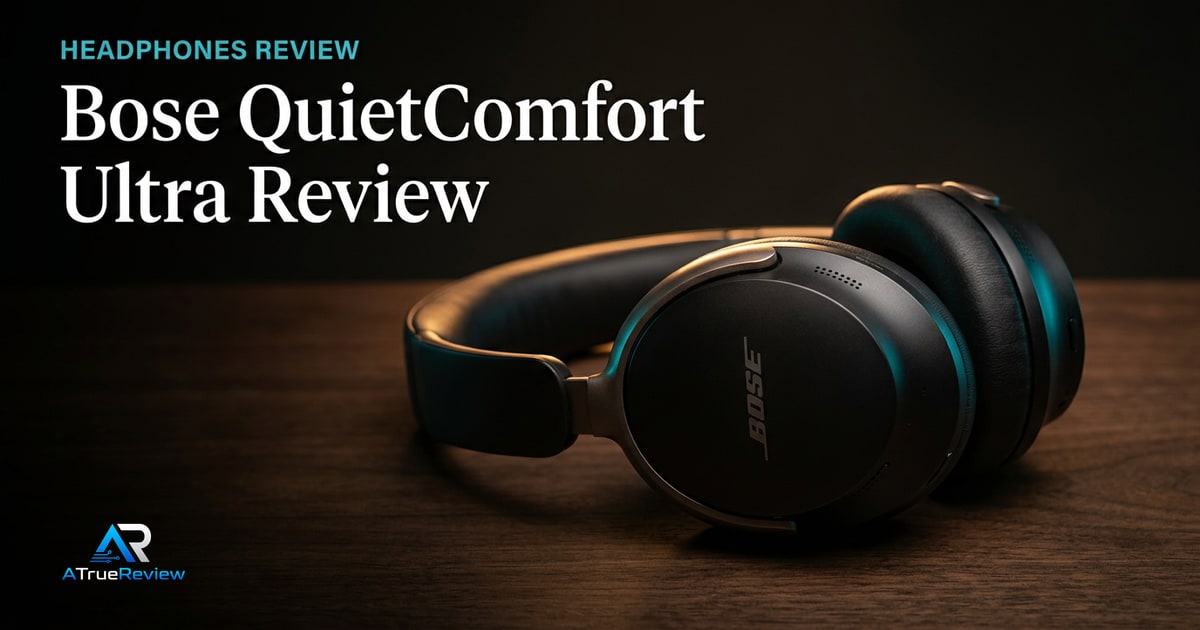
Headphone review
A review of Bose's premium noise-canceling headphones, focused on whether comfort, quiet, calls, and daily ease justify the premium over longer-battery or broader-codec rivals.
Verdict
Recommended
A strong comfort-and-ANC candidate for buyers who want travel quiet and daily ease before raw feature count.

Best for
Frequent travelers, office listeners, and people who wear headphones for long stretches.
Skip if
You want the longest battery life, the broadest codec sheet, or a final hands-on ranking rather than a launch-stage evaluation.
Test window
Launch brief based on official Bose product data and category comparison. Hands-on retesting is still required before final scoring.
Specs
Key findings
The Bose QuietComfort Ultra Headphones are the cleanest answer to a specific question: which premium noise-canceling headphones should you buy if you do not want to turn headphone shopping into a hobby? The pitch is focused — quiet, comfort, calls, daily ease — and Bose has not tried to win every spec column. That is the entire reason they remain easy to recommend.
For frequent travelers, office workers who actually wear headphones eight hours a day, and people who live in noisy environments, “win every spec column” is not the buying criterion. “Forget I am wearing them” is.
The strongest case is the combination of comfort and quiet. Bose’s official product page lists world-class noise cancellation, an 8-microphone system for adaptive feedback and feed-forward noise reduction, Bluetooth 5.3 with Multipoint, clear-call positioning, Immersive Audio, and up to 24 hours of battery life in Quiet or Aware mode (18 hours with Immersive Audio enabled).
The headphones genuinely live at the top of the comfort tier. The cushioned earcups, even clamping pressure, and modest 250-gram weight make multi-hour wear meaningfully easier than most competitors. For office and travel buyers who put on headphones at 9 AM and take them off at 5 PM, that comfort difference is the most important spec.
The call story is the second underrated win. The 8-microphone array does well rejecting background noise, and call recipients consistently report clear voice. For a single headset used across music, ANC, and meetings, the QuietComfort Ultra is one of the most versatile picks in the category.
That depends on what the buyer is actually paying for. The Bose does not win the value argument by brute-force specs. It wins when the buyer will feel the difference in comfort, quiet, and call ease often enough that those benefits matter more than battery bragging rights or codec coverage.
If the headphones will mainly be used on flights, in open offices, or across long workdays, the price makes more sense. Those are the environments where reduced fatigue and calmer ANC behavior compound. If the buyer mostly listens at home, rarely travels, or cares more about long battery life and codec flexibility, the premium gets harder to justify against Sony or Sennheiser.
This page should not pretend the verdict is complete. The most important final tests are long-session clamp comfort over multi-week real use, heat buildup with sustained ANC, real-world call pickup in noisy rooms, ANC behavior across plane / train / open office, app reliability, and whether Immersive Audio is worth the battery cost in daily listening.
The Bose wins where you wear them every day. It loses where you compare spec sheets at the store.
— The honest framing
Two specific limitations matter for some buyers. First, no LDAC support — Android users with hi-res libraries lose codec headroom that Sony and Sennheiser offer. For most listeners on streaming services, this does not matter; for FLAC-library audiophiles, it does. Second, battery life trails Sony’s 30-hour and Sennheiser’s 60-hour ratings on paper. Whether that gap matters depends on whether you actually run out between charges in real use.
Before any final scoring, the site needs to test multi-week comfort, ANC across multiple environments, call quality on multiple platforms, app stability, codec behavior on Android and iOS, and the practical battery drain across mixed use.
The premium over-ear ANC segment has settled into four real choices:
The Sony WH-1000XM6 is the spec-sheet winner — longer battery life, broader codec support including LDAC, more aggressive feature stack, often slightly cheaper. Better for Android audiophiles and buyers who prioritize spec coverage. Slightly less comfortable for some heads over very long sessions.
The Sennheiser Momentum 4 Wireless is the music-first pick. 60-hour battery life, neutral tuning, less prominent ANC than Bose or Sony. Better for committed listeners who want the headphones to disappear musically rather than dominate the experience.
The Apple AirPods Max are the right pick for buyers deep in the Apple ecosystem who want seamless device switching, spatial audio integration, and don’t mind the weight or premium price.
The Bose QuietComfort Ultra wins when comfort and ANC quality are the primary criteria and you do not want to think about codec or feature complexity. For most office and travel buyers, that is the right framing.
For shortlist context around that decision, the best wireless headphones guide shows where Bose sits relative to Sony and AirPods Max, the headphones category narrows the audio-only layer, and the wider audio hub helps buyers decide whether the real issue is headphones or the broader listening setup. For office buyers building a complete focus-friendly desk, the Dell UltraSharp U2725QE handles the visual side, the Logitech Wave Keys covers the typing comfort, and the Framework Laptop 13 is the modular laptop pairing.
If you are buying premium ANC headphones primarily for travel, office focus, or daily long-session use and value comfort and quiet over codec breadth, the QuietComfort Ultra is the right answer. If you are an Android audiophile who values LDAC and 30-hour battery life, the Sony WH-1000XM6 is the honest alternative. If music tuning and 60-hour battery life matter most, the Sennheiser Momentum 4 is the better fit. If you live in the Apple ecosystem, the AirPods Max integrates more deeply.
The provisional verdict: still the safest comfort-and-ANC default in the premium segment. Final score depends on multi-week comfort, ANC, and call testing, but the positioning is sound and unlikely to change. For shortlist context, route back through best wireless headphones, headphones, or the wider audio hub.
Verdict shape
Pros
Cons
Alternatives
FAQ
Among the top three for sure, alongside the Sony WH-1000XM6 and the Apple AirPods Max. "Best" depends on what you mean — Bose tends to win on the natural feel of the noise reduction (less pressure-sensation), Sony wins on raw measured noise reduction in some scenarios. Both are well within the "you can wear these on a plane and feel the difference" tier.
Strong, and a real reason to consider this headset for work use. The 8-microphone array does well rejecting room and street noise, and call recipients consistently report clear voice. For a single device that handles music, ANC, and calls, the QuietComfort Ultra is one of the cleanest picks.
It is a personal-taste feature, not a universal upgrade. Some listeners love the spatial expansion on certain music; others find it slightly disorienting on familiar tracks. Battery life drops to 18 hours when enabled (vs 24 for standard modes). Worth turning on for movies and certain genres; worth turning off for critical listening.
Easily. Multipoint lets you stay paired to your phone and your laptop simultaneously — answer a call from the phone, switch back to the laptop without re-pairing. For a laptop-and-monitor desk like a [Dell UltraSharp U2725QE](/reviews/dell-ultrasharp-u2725qe-review/) setup, the QuietComfort Ultra is the focus-and-call headphone of choice.
Bose's 24-hour figure (Quiet/Aware) holds up in real-world use for moderate-volume listening. Heavy-volume listening, lots of multipoint switching, and Immersive Audio shorten the figure. For comparison, the Sony WH-1000XM6 advertises 30 hours and the Sennheiser Momentum 4 advertises 60. Bose loses the battery-life arms race; whether you care depends on whether you actually run out between charges.
Up to 24 hours in Quiet or Aware mode, or up to 18 hours with Immersive Audio.
Yes. SBC, AAC, and aptX Adaptive (Snapdragon Sound) over Bluetooth 5.3 with Multipoint.
Yes, an Immersive listening mode for spatial audio, alongside Quiet and Aware modes.
Over USB-C, with a full charge in about 3 hours and a quick-charge that gives 2.5 hours of use from 15 minutes.
Yes, a 2.5 mm to 3.5 mm cable is included; the headphones weigh about 250 g.