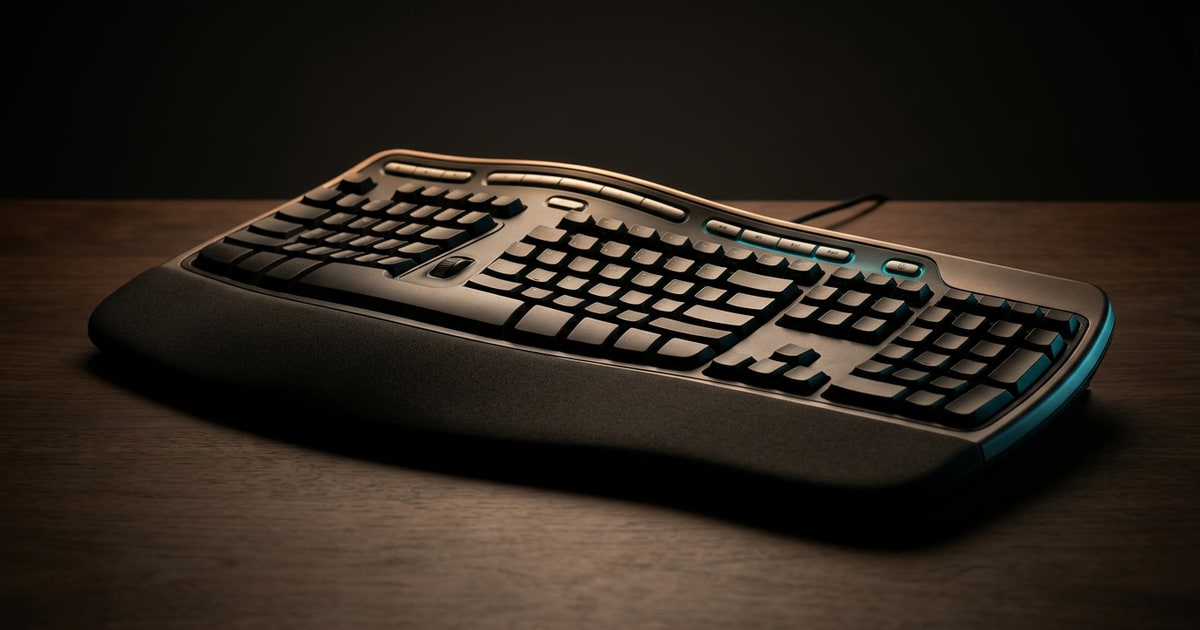
What the Microsoft Natural Ergonomic Keyboard 4000 still gets right
The reason people still search for the Microsoft Natural Ergonomic Keyboard 4000 is simple: it solves the ergonomic problem in a way that feels conservative instead of radical. Microsoft’s own product sheet centered the keyboard around a 14-degree gable, a natural arc, a curved key bed, and an optional seven-degree reverse slope via the snap-in palm lift. Those are not marketing flourishes. They explain why the board felt easier to adopt than fully split enthusiast options.Microsoft product sheet
That is still the strongest case for it today. If you spend all day in email, documents, spreadsheets, and browser tabs, the 4000 gives you a more relaxed wrist posture without asking you to relearn your entire typing environment. The dedicated zoom control and office-friendly hotkeys also make sense in exactly that kind of workflow.Microsoft product page
Where the age shows
The Microsoft Natural Ergonomic Keyboard 4000 is no longer a modern ergonomic benchmark. It is a historically important ergonomic office keyboard that survives because the shape was good enough to build loyalty.
The biggest issue is not the layout. It is everything around the layout:
- it is discontinued and therefore awkward to replace
- it is wired in an era where many desk setups have moved to cleaner wireless options
- it is less adjustable than newer ergonomic boards
- the feel is functional rather than premium
That last point matters. The 4000 still works for people who want comfort with minimal adaptation, but it does not feel like a high-end typing tool anymore. It feels like a practical Microsoft office peripheral from a different era, because that is exactly what it is.
Comfort versus adjustability
This is where search intent usually gets muddled. People often search “Microsoft Natural Ergonomic Keyboard 4000 review” because they are not only curious about the board itself. They are trying to decide whether it is worth buying used, refurbished, or old-stock instead of just moving to a newer ergonomic keyboard.
The honest answer is that the 4000 wins on familiarity and loses on ceiling.
If you want:
- a full-size board
- a split shape that still feels recognizably mainstream
- a palm rest integrated into the experience
- a fast adjustment period
then the 4000 still has a rational audience.
If you want:
- deeper ergonomic separation
- tenting flexibility
- quieter or better switch feel
- current software support and easier replacement
then you are paying for nostalgia and layout familiarity more than outright keyboard quality.
SEO reality: who should still care?
The best search-intent fit for the Microsoft Ergonomic Keyboard 4000 in 2026 is the person who has already used one before, or the person who has tried cheaper “ergonomic” boards and wants something safer and more familiar.
It is a weaker recommendation for first-time buyers starting from scratch. The modern ergonomic category has moved on. Microsoft itself has long since shifted its lineup, and even Microsoft’s own hosted answers now frame the old model as legacy hardware rather than a current destination product.Microsoft Q&A
Bottom line
The Microsoft Natural Ergonomic Keyboard 4000 remains one of the clearest examples of why fixed-split office keyboards became popular in the first place. It is comfortable, approachable, and still genuinely useful for long typing sessions. But it is no longer the best ergonomic keyboard for most buyers. It is the best keyboard for the buyer who specifically wants this shape, this layout, and this style of transition away from flat office boards.